


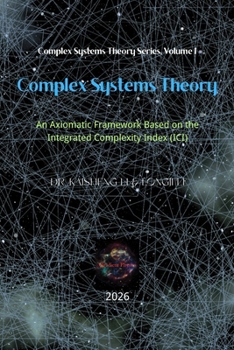
Complex Systems Theory: An Axiomatic Framework Based on the Integrated Complexity Index (ICI)
No Customer Reviews

This book develops a formal theory of integrated complexity for systems that generate, maintain, and transform order through information processing, feedback, memory, and boundary-mediated regulation. At its center is the Integrated Complexity Index (ICI), a six-parameter framework built from three baseline-capacity dimensions-diversity, scale, and reaction throughput-and three emergent-integration dimensions-feedback density, effective interaction frequency, and weighted memory complexity. The book argues that complexity is not merely a matter of size, connectivity, or computational capacity, but arises when these dimensions are jointly organized into a self-maintaining structure capable of adaptive regulation.
The theory proceeds in five steps. First, it defines the six parameters and derives the ICI structure from information geometry, thermodynamic constraints, control theory, and nonlinear dynamics, yielding a logarithmic baseline term, a square-root emergent term, and a multiplicative coupling between capacity and integration. Second, it formulates a theory of autonomous transition, distinguishing non-autonomous complexification from autonomous systems through the emergence of functional feedback, effective temporal coordination, and callable memory. Third, it analyzes the generative mechanisms of emergence: feedback loops through Hopf bifurcation, interaction frequency through phase synchronization, memory depth through error-threshold dynamics, and evolvability through modularity, block-diagonal information geometry, and resilience-efficiency trade-offs.
The fourth part establishes the theory's constraint laws. It argues that a designed system cannot, as a mere external projection, exceed the integrative complexity of its designer unless endogenous emergence or self-evolution alters the premise of projection. It also derives an energy-complexity scaling law, according to which the energetic cost of maintaining integration grows as a power of ICI, with digital discretization, coordination overhead, and feedback imbalance imposing hard limits on further growth. The fifth part situates the framework in relation to existing theories of complexity. Dissipative-structure theory, cybernetics and network theory, integrated information theory, and the free-energy principle are interpreted as parameter projections or limiting cases of the ICI framework rather than as competing accounts.
The book concludes by testing its own logical closure and scientific vulnerability. It provides a theorem-dependence map to show that the argument is non-circular, formulates hard falsification conditions concerning consciousness ranking, collapse thresholds, autonomy without FWM, and the geometric derivation of the ICI formula, and identifies two open problems: the quantum-classical boundary of information integration and the possible absolute upper bound of continuous-state integrated information. In doing so, the book presents ICI not as a metaphor for complexity, but as a falsifiable research program for comparing autonomous and non-autonomous systems across biological, cognitive, ecological, economic, and historical domains.
The theory proceeds in five steps. First, it defines the six parameters and derives the ICI structure from information geometry, thermodynamic constraints, control theory, and nonlinear dynamics, yielding a logarithmic baseline term, a square-root emergent term, and a multiplicative coupling between capacity and integration. Second, it formulates a theory of autonomous transition, distinguishing non-autonomous complexification from autonomous systems through the emergence of functional feedback, effective temporal coordination, and callable memory. Third, it analyzes the generative mechanisms of emergence: feedback loops through Hopf bifurcation, interaction frequency through phase synchronization, memory depth through error-threshold dynamics, and evolvability through modularity, block-diagonal information geometry, and resilience-efficiency trade-offs.
The fourth part establishes the theory's constraint laws. It argues that a designed system cannot, as a mere external projection, exceed the integrative complexity of its designer unless endogenous emergence or self-evolution alters the premise of projection. It also derives an energy-complexity scaling law, according to which the energetic cost of maintaining integration grows as a power of ICI, with digital discretization, coordination overhead, and feedback imbalance imposing hard limits on further growth. The fifth part situates the framework in relation to existing theories of complexity. Dissipative-structure theory, cybernetics and network theory, integrated information theory, and the free-energy principle are interpreted as parameter projections or limiting cases of the ICI framework rather than as competing accounts.
The book concludes by testing its own logical closure and scientific vulnerability. It provides a theorem-dependence map to show that the argument is non-circular, formulates hard falsification conditions concerning consciousness ranking, collapse thresholds, autonomy without FWM, and the geometric derivation of the ICI formula, and identifies two open problems: the quantum-classical boundary of information integration and the possible absolute upper bound of continuous-state integrated information. In doing so, the book presents ICI not as a metaphor for complexity, but as a falsifiable research program for comparing autonomous and non-autonomous systems across biological, cognitive, ecological, economic, and historical domains.
Format:Paperback
Language:English
ISBN:B0H6VXBSM1
ISBN13:9798184770321
Release Date:June 2026
Publisher:Independently Published
Length:330 Pages
Weight:0.97 lbs.
Dimensions:0.7" x 6.0" x 9.0"
Customer Reviews
0 rating
Copyright © 2026 Thriftbooks.com
Terms of Use | Privacy Policy | Do Not Sell/Share My Personal Information | Cookie Policy | Cookie Preferences | Accessibility Statement
ThriftBooks ® and the ThriftBooks ® logo are registered trademarks of Thrift Books Global, LLC
ThriftBooks ® and the ThriftBooks ® logo are registered trademarks of Thrift Books Global, LLC
