


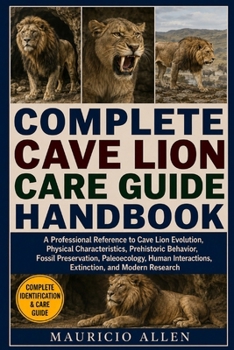
Complete Cave Lion Care Guide Handbook: A Professional Reference to Cave Lion Evolution, Physical Characteristics, Prehistoric Behavior, Fossil Preser

Step into the prehistoric world of one of the most formidable predators ever to roam the Ice Age landscape.
CAVE LION CARE GUIDE HANDBOOK is a comprehensive and educational reference exploring the remarkable natural history, evolution, anatomy, ecology, fossil record, and scientific significance of the extinct cave lion (Panthera spelaea). Designed for wildlife enthusiasts, students, educators, fossil collectors, amateur paleontologists, and readers fascinated by prehistoric mammals, this handbook brings together essential knowledge about this extraordinary member of the cat family.
Travel back to the Pleistocene and discover how cave lions evolved, spread across vast regions of Eurasia and Beringia, and adapted to some of the harshest environments experienced by large terrestrial predators. Explore their powerful anatomy, physical characteristics, hunting ecology, possible social behavior, prey relationships, and interactions with mammoths, steppe bison, horses, reindeer, cave hyenas, wolves, cave bears, and early humans.
Inside this handbook, you will discover:
- The evolutionary origins, taxonomy, and classification of the cave lion
- Physical characteristics and adaptations to demanding Ice Age environments
- Geographic distribution and major prehistoric habitats
- Hunting behavior, feeding ecology, and relationships with large herbivores
- Competition and interactions with other Pleistocene predators
- Fascinating encounters between cave lions and prehistoric humans
- Cave paintings, archaeological evidence, and the cultural importance of lions
- Major cave lion fossil discoveries and excavation techniques
- Professional approaches to fossil preparation, preservation, and conservation
- Ancient DNA, stable isotope analysis, CT scanning, and other modern research methods
- Paleoecology and reconstruction of the mammoth-steppe ecosystem
- Important cave lion fossil sites across Europe, Asia, Siberia, Beringia, and North America
- Scientific techniques used to create evidence-based cave lion reconstructions
- Climate change, prey decline, habitat transformation, and theories surrounding extinction
- Museum collection management, education, public outreach, and the continuing scientific legacy of Panthera spelaea
Rather than treating the cave lion as simply another extinct animal, this book places it within the complex ecological system that supported some of the greatest mammals of the Pleistocene. It explains how predators, prey, climate, vegetation, and early humans interacted and how dramatic environmental transformations eventually reshaped these ancient communities.
Readers will also discover how modern technologies are changing what scientists can learn from fossils. Ancient DNA sequencing, three-dimensional imaging, radiocarbon dating, isotope analysis, environmental DNA, biomechanical modeling, and advanced digital reconstruction are revealing details about cave lion evolution and ecology that previous generations of researchers could only imagine.
Accessible enough for curious beginners while offering substantial information for serious wildlife and paleontology enthusiasts, CAVE LION CARE GUIDE HANDBOOK provides an engaging journey through the science of one of prehistory's most impressive carnivores.
Discover the evidence. Explore the Ice Age. Understand the predator.
Begin your journey into the extraordinary world of the cave lion today.
Related Subjects
NatureCustomer Reviews
ThriftBooks ® and the ThriftBooks ® logo are registered trademarks of Thrift Books Global, LLC
