


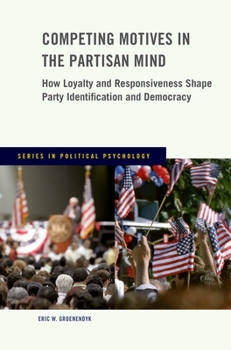
Competing Motives in the Partisan Mind: How Loyalty and Responsiveness Shape Party Identification and Democracy
No Customer Reviews

Select Format
Select Condition 
Book Overview
Party identification may be the single most powerful predictor of voting behavior, yet scholars continue to disagree on whether this is good or bad for democracy. Some argue that party identification functions as a highly efficient information shortcut, guiding voters to candidates that represent their interests. Others argue that party identification biases voters' perceptions, thereby undermining accountability. Competing Motives in the Partisan Mind provides a framework for understanding the conditions under which each of the characterizations is most apt. The answer hinges on whether a person has sufficient motivation and ability to defend her party identity or whether norms of good citizenship motivate her to adjust her party identity to reflect her disagreements. A series of surveys and experiments provide a window into the partisan mind during times of conflict between party identity and political attitudes. These studies show that individuals devote cognitive resources to defending their party identities against dissonant thoughts, often resorting to elaborate justifications. However, when cognitive resources are insufficient, these defenses break down and partisans are forced to adjust their identities to reflect disagreements. In addition, thoughts of civic duty can stimulate responsiveness motivation to the point that it overwhelms partisan motivation, leading individuals to adjust their identities to reflect their disagreements. In demonstrating the influence of competing motives, this book reconciles the two dominant theories of party identification. Rather than characterizing party identification as either a highly stable affective attachment or a running tally of political evaluations, it suggests that the nature of party identification hinges on the interplay between the motivations that underlie it. Perhaps even more importantly, this book shifts the discussion away from partisan change versus stability to the normative implications of party identification. While the polarization of American politics may be exacerbating partisan biases, there is plenty of reason for hope. By simply making citizens' widespread feelings of civic duty salient to them, these biases may be overcome.
Format:Paperback
Language:English
ISBN:0190264306
ISBN13:9780190264307
Release Date:August 2015
Publisher:Oxford University Press
Length:224 Pages
Weight:0.80 lbs.
Dimensions:0.6" x 6.0" x 9.1"
Customer Reviews
0 rating
Copyright © 2026 Thriftbooks.com
Terms of Use | Privacy Policy | Do Not Sell/Share My Personal Information | Cookie Policy | Cookie Preferences | Accessibility Statement
ThriftBooks ® and the ThriftBooks ® logo are registered trademarks of Thrift Books Global, LLC
ThriftBooks ® and the ThriftBooks ® logo are registered trademarks of Thrift Books Global, LLC
