


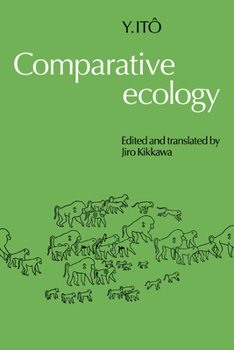
Comparative Ecology
No Customer Reviews

Select Format
Select Condition 
Book Overview
This 1980 book considers the patterns of population fluctuations of animals and intraspecific social relations by means of comparative methods and discusses the evolution of population regulation mechanisms and social relations. The author proposes that parental care has evolved in environments in which it is difficult for the young to obtain food, whilst high fecundity has evolved in the opposite environment. He presents evidence from a wide range of organisms to argue that during evolution animals repeatedly face the 'choice' of two strategies - low fecundity combined with parental protection, or high fecundity - and that this choice determined the amplitude, regularity and associated main factors of population fluctuations as well as the main characteristics of social relations as expressed in group life or dispersed living involving territory. Although many examples are drawn from insects, with which the author is most familiar, mammal, birds and other animal groups are also examined in depth.
Format:Paperback
Language:English
ISBN:0521298458
ISBN13:9780521298452
Release Date:April 1981
Publisher:Cambridge University Press
Length:450 Pages
Weight:1.44 lbs.
Dimensions:1.0" x 6.0" x 9.0"
Customer Reviews
0 rating
Copyright © 2026 Thriftbooks.com Terms of Use
| Privacy Policy | Do Not
Sell/Share My Personal Information | Cookie Policy | Cookie Preferences | Accessibility Statement
ThriftBooks® and the ThriftBooks® logo are registered trademarks of Thrift Books Global, LLC
ThriftBooks® and the ThriftBooks® logo are registered trademarks of Thrift Books Global, LLC
