


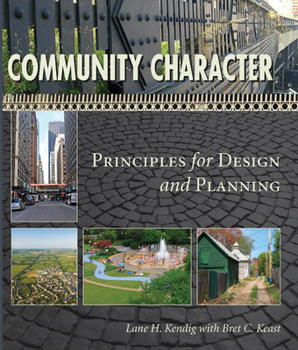
Community Character: Principles for Design and Planning
No Customer Reviews

Community Character provides a design-oriented system for planning and zoning communities but accounts for how people who participate in a community live, work, and shop there. The relationships that Lane Kendig defines here reflect the complexity of the interaction of the built environment with its social and economic uses, taking into account the diverse desires of municipalities and citizens. Among the many classifications for a community's "character" are its relationship to other communities, its size and the resulting social and economic characteristics. According to Kendig, most comprehensive plans and zoning regulations are based entirely on density and land use, neither of which effectively or consistently measures character or quality of development. As Kendig shows, there is a wide range of measures that define character and these vary with the type of character a community desires to create. Taking a much more comprehensive view, this book offers "community character" as a real-world framework for planning for communities of all kinds and sizes. A companion book, A Practical Guide to Planning with Community Character, provides a detailed explanation of applying community character in a comprehensive plan, with chapters on designing urban, sub-urban, and rural character types, using character in comprehensive plans, and strategies for addressing characteristic challenges of planning and zoning in the 21st century.
Format:Paperback
Language:English
ISBN:1597266965
ISBN13:9781597266963
Release Date:July 2010
Publisher:Island Press
Length:208 Pages
Weight:1.00 lbs.
Dimensions:0.6" x 8.4" x 9.8"
Customer Reviews
0 rating
Copyright © 2026 Thriftbooks.com Terms of Use
| Privacy Policy | Do Not
Sell/Share My Personal Information | Cookie Policy | Cookie Preferences | Accessibility Statement
ThriftBooks® and the ThriftBooks® logo are registered trademarks of Thrift Books Global, LLC
ThriftBooks® and the ThriftBooks® logo are registered trademarks of Thrift Books Global, LLC
