
Skip to content
Scan a barcode
Scan
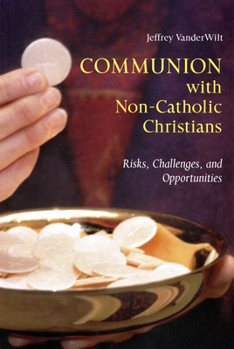
Paperback Communion with Non-Catholic Christians: Risks, Challenges, and Opportunities Book

ISBN: 0814628958

ISBN13: 9780814628959

Communion with Non-Catholic Christians: Risks, Challenges, and Opportunities

Select Format

Select Condition ThriftBooks Help Icon

Recommended

Format: Paperback

Condition: New

$17.53
Save $1.42!
List Price $18.95
Ships within 2-3 days
Save to List

Book Overview

Is it ever appropriate for non-Catholic Christians to receive Holy Communion at a Catholic Mass? What should a pastor do to preserve the holiness and the purpose of Communion? What happens when a non-Catholic receives Holy Communion? How should a Catholic pastor respond to non-Catholics who wish to have communion without conveying harshness, scrupulosity, legalism, or rudeness? Intended to help Christians recognize the present provisional norms and to see new possibilities in eucharistic sharing, Communion with Non-Catholic Christians examines the risks, challenges, and opportunities involved in the admission of communion to non-Catholic Christians.

Communion with Non-Catholic Christians begins by defining eucharistic sharing. It assists Catholics and non-Catholics in understanding the present discipline of eucharistic sharing or receiving Holy Communion outside of one's own church. Secondly, it looks at what caution should be taken in eucharistic sharing, the values at stake, and the reasons for more open eucharistic sharing for Christian unity. Finally, it looks at the opportunities in eucharistic sharing and the possibility of full communion. By focusing on liturgical law and pastoral practices, this book moves the discussion of the admission of communion forward to new possibilities for growth in communion.

Chapters are: "What is Eucharistic Sharing?" ?Risks, or Some Reasons for Caution in Eucharistic Sharing, ? ?Challenges, or Some Reasons for a More Open Eucharistic Sharing, ? and ?Opportunities, or Sharing the Eucharist in Hope for Full Communion.?

Customer Reviews

1 rating

One bread, one body, one Lord of all...

One of the perennial problems in Christianity is how to bring about the unity we all say we want, but don't seem to practice very well. Even those practices that are supposed to be outward signs of greater unity, either of divine essence and presence or of community, tend toward division and, not uncommonly, rancor. The celebration of the Eucharist, the Lord's Supper, Communion (even the litany of names belies the difficulties here) is sometimes called the great symbol of Christian disunity, for so much energy is expended upon deciding who can celebrate and who can partake. This book by Jeffrey VanderWilt, a professor of liturgy, sacraments and theology at Marymount University (Los Angeles), looks at the problems of Roman Catholics and non-Roman Catholics sharing communion. VanderWilt combines both story and theory, recounting real issues that have arisen, as well as hypotheticals, and uses these to demonstrate the points. He addresses some high profile cases - Bill Clinton (a Baptist) once received communion at a Roman Catholic mass while visiting Soweto, in South Africa; Tony Blair (an Anglican) used to regularly receive communion at the local parish that his family attended (Blair's wife is Roman Catholic). These were high-profile cases because of the personalities involved, but interestingly the issues arising where not due to the political rank, but go to deeper issues in eucharistic sharing, and serve to highlight the difficulties even a heavily-canon-codified institution such as the Roman Catholic church can have. For example, Blair was told that he should stop receiving communion from the Roman Catholic church, as there were Anglican parishes nearby where he could received. He was told, in somewhat of an irony, that were he on holiday in Tuscany, where there were no Anglican parishes nearby, it would be acceptable for him to receive communion there. If this sounds inconsistent with regard to ontological reasoning about what takes place during communion, you might be on to something.VanderWilt has four main sections. The first deals with basic definitions - what is Eucharistic sharing, what is ecumenism, etc. Again, because of the variation in practice and theology, there is no single definition operative here. The second section deals with risks involved in Eucharistic sharing - high on this list for VanderWilt is the appearance of a false sense of unity; VanderWilt in the end concludes that few of the risks are grave enough to warrant a lack of Eucharistic sharing.The third and fourth sections - challenges and opportunities - are the heart of the book. The challenges such as call to pastoral care for each other and call for hospitality all ring true as credible and appropriate to gospel witness. The opportunities for increased unity, increased community, and increased recognition of God in our lives and the lives of others, for VanderWilt, far outweigh the difficulties that might be involved. When Blair asked, in response
Copyright © 2026 Thriftbooks.com Terms of Use | Privacy Policy | Do Not Sell/Share My Personal Information | Cookie Policy | Cookie Preferences | Accessibility Statement
ThriftBooks® and the ThriftBooks® logo are registered trademarks of Thrift Books Global, LLC

GoDaddy Verified and Secured