


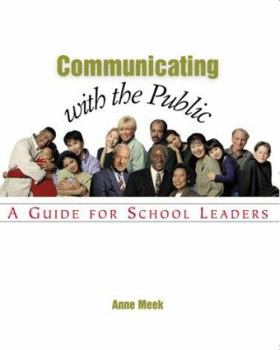
Communicating with the Public: A Guide for School Leaders

In this book, former educator, administrator, and Educational Leadership Managing Editor Anne Meek urges K-12 educational leaders to move beyond the all-too-familiar "crisis communications" approach... This description may be from another edition of this product.
Format:Paperback
Language:English
ISBN:087120343X
ISBN13:9780871203434
Release Date:August 1999
Publisher:Assn for Supervision & Curriculum
Length:144 Pages
Weight:0.75 lbs.
Dimensions:10.3" x 0.3" x 8.3"
Customer Reviews
1 rating
A Must for Anyone With Influence
Published by Thriftbooks.com User , 16 years ago
Communicating With the Public is an excellent specimen of wise advice. Let me give you a synopsis of the chapters, to better help you evaluate your decision on whether or not to buy this book: Chapter 1: The Communication Imperative: Making Friends Before You Need Them. In this chapter it talks about different ways to make your community proactive in communication, how to strengthen parent school partnerships, and promoting school activities and events. This boiled down to finding different ways to communicate to the public about schools. Chapter 2: Planning to Communicate. The main thing chapter 2 focused on was planning to communicate. In order to be a proactive communicator you have to plan everything thoroughly, and when you plan everything your audience will be pleased and satisfied. Chapter 3: Shaping Your Message for Your Audience. Is mainly about picking and molding your speeches to fit different audiences, for the simple fact that not every person understands the information from the same speech. Chapter 4: Creating a Positive Climate. This chapter discusses how to present a product or something in that nature as well as how good that product is. In the chapter it states that "communication alone cannot convince people", you need some type of evidence proving your statement. Chapter 5: Linking Communication to Community Relations. The importance of chapter 5 is that, we as people have to learn how to not just communicate with people, but form a relation with that person or that audience you're communicating with. Chapter 6: Spotlighting the Good News: Media Liaisons. I bet you're wondering what a Media Liaisons is. "A Media Liaison is a school employee who acts as a publicity Chair for that school. He or she prepares news releases, promotes media attention for programs and events". In English another communicator for the community. Chapter 7: Coordinating School and Central Office Responsibilities. Coordinating school and central office responsibilities mainly talked about, when trying to get things done effectively and efficiently everyone must know their job when communicating to the media, and the community, to also ensure that no one is viewing the school system negatively. Chapter 8: Communications From the central Office Perspective. The roles of a central office communicator were defined in chapter 8. Their job is basically to do anything and everything for their superintendent. They have to attend boring meetings, organize news conferences, and inform the public at all times on what is going on in the school. Chapter 9: Evaluating Your Communications Program. It's basically reminding you that you must document everything you did to build your communications program, so that in the future it will be perfected if not already. Chapter 10: Think Courtship. Chapter 10 listed major concepts in building you communications program, which were stated in chapter 1-9. This book basically showed you how t
Copyright © 2026 Thriftbooks.com Terms of Use
| Privacy Policy | Do Not
Sell/Share My Personal Information | Cookie Policy | Cookie Preferences | Accessibility Statement
ThriftBooks® and the ThriftBooks® logo are registered trademarks of Thrift Books Global, LLC
ThriftBooks® and the ThriftBooks® logo are registered trademarks of Thrift Books Global, LLC
