


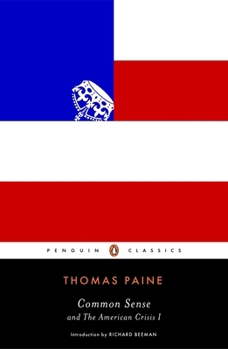
Common Sense: And the American Crisis I

Select Format
Select Condition 
Book Overview
The writings that inspired the American Revolution--in an expanded new edition Thomas Paine's Common Sense may well be the most influential polemic in all of American history. Published anonymously in 1776, six months before the Declaration of Independence, this incendiary call for Americans to revolt against British rule converted millions to the cause of independence and set out a vision of a just society liberated from the yoke of the crown. Paine's pamphlet was the first to speak directly to a mass audience--and his assertive and often caustic style embodied the democratic spirit he advocated. This expanded edition also features Paine's The American Crisis I , the first in a series of pamphlets aimed at bolstering American morale during the Revolution. An introduction by preeminent constitutional expert Richard Beeman traces Paine's origins and illuminates the significance of these writings. For more than sixty-five years, Penguin has been the leading publisher of classic literature in the English-speaking world. With more than 1,500 titles, Penguin Classics represents a global bookshelf of the best works throughout history and across genres and disciplines. Readers trust the series to provide authoritative texts enhanced by introductions and notes by distinguished scholars and contemporary authors, as well as up-to-date translations by award-winning translators.
Format:Paperback
Language:English
ISBN:0143107593
ISBN13:9780143107590
Release Date:June 2015
Publisher:Penguin Classics
Length:128 Pages
Weight:0.69 lbs.
Dimensions:0.4" x 5.2" x 7.8"
Age Range:18 years and up
Grade Range:Grade 12 and higher
Customer Reviews
2 ratings
Relevant for today, as you can see, many parallels.
Published by bernie4444 , 8 months ago
“… let none be heard among us, then those of A GOOD CITIZEN, AN OPEN AND RESOLUTE FRIEND, AND A VIRTUOUS SUPPORTER OF THE RIGHTS OF MANKIND…”
If you don't see the above quote in your copy, there are different copies of "Common Sense" with some variances. All have the standard four chapters; additions contain other materials... many other titles are "Common Sense and Other Writings by Thomas Paine."
As you read “Common Sense," you'll realize there are several ways to approach this information. One way is to consider it in the context of the period it was written in, one of its target readers might be. Another is to see how it applies to today's life. I chose a combination of both approaches. I also thought I knew the Bible well, but found that I had to look up some quotations he used.
Well, I won't go into detail because I don't want to spoil the surprise of how well he writes on the subject(s). I will say this is one of those books you want to read before you die, but I prefer to read it early so I can live by what I have read. Also, I was surprised, as with most people quoting things like the Constitution or the Bill of Rights and so forth, they always quote the large esoteric statements or concepts and forget to tell you that it can get bogged down with tedium. This is not the case with “Common Sense,” as almost every one of his sentences is a standalone, timeless thought.
Now, watch “Liberty! The American Revolution” TV mini-series.
(1997) 6 hours Jane Adams (Actor), Peter Donaldson (Actor), Ellen Hovde (Director), Muffie Meyer (Director)
We have it in our power to begin the world over again
Published by Thriftbooks.com User , 18 years ago
This was a required reading for a graduate humanities class. John Keane's biography succinctly showed that Tom Paine (1737-1809) was the consummate revolutionary and a daring adventurer. Not only was he an important figure in the American Revolution, but he also traveled to France in 1791 to give that revolution a push. Paine traveled from England, just in time to stoke the flames of the revolution with his pamphlet Common Sense, in January 1776. To call Common Sense a sensation in the colonies is actually a bit of an understatement. It was an unparallel sensation and monumental work of Enlightenment rhetoric that quickly fanned the flames of rebellion throughout the colonies. In four months, over 120,000 copies were printed in the colonies--over 500,000 copies by years end. No other pamphlet printed in seventeenth century America came close to its success. Most importantly, Common Sense served to get the colonial patriots to drop their fear of open rebellion, and also emboldened those delegates who favored declaring independence from Britain. The delegates now had the confidence that a large segment of the colonists would support rebellion. Similar to the Declaration of Independence, the philosophical ideas in Common Sense are primarily from the English philosopher, John Locke (1632-1704). The most moving quote from the pamphlet became quite prophetic, when one considers the impact it ultimately had on the delegates in the congress, the drafting of the Declaration of Independence, and on the world. "We have it in our power to begin the world over again." As a graduate student in philosophy and history, I heartily recommend this timeless classic to anyone who is interested in political philosophy, and history.
Copyright © 2026 Thriftbooks.com Terms of Use
| Privacy Policy | Do Not
Sell/Share My Personal Information | Cookie Policy | Cookie Preferences | Accessibility Statement
ThriftBooks® and the ThriftBooks® logo are registered trademarks of Thrift Books Global, LLC
ThriftBooks® and the ThriftBooks® logo are registered trademarks of Thrift Books Global, LLC
