


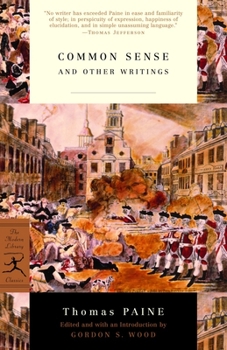
Common Sense: And Other Writings

Select Format
Select Condition 
Book Overview
Includes the complete texts of Common Sense; Rights of Man, Part the Second; The Age of Reason (part one); Four Letters on Interesting Subjects , published anonymously and just discovered to be Paine's work; and Letter to the Abbe Raynal, Paine's first examination of world events; as well as selections from The American Crises In 1776, America was a hotbed of enlightenment and revolution. Thomas Paine not only spurred his fellow Americans to action but soon came to symbolize the spirit of the Revolution. His elegantly persuasive pieces spoke to the hearts and minds of those fighting for freedom. He was later outlawed in Britain, jailed in France, and finally labeled an atheist upon his return to America.
Format:Paperback
Language:English
ISBN:0375760113
ISBN13:9780375760112
Release Date:February 2003
Publisher:Modern Library
Length:352 Pages
Weight:0.84 lbs.
Dimensions:0.7" x 5.2" x 8.1"
Customer Reviews
2 ratings
Relevant for today, as you can see, many parallels.
Published by bernie4444 , 6 months ago
“… let none be heard among us, then those of A GOOD CITIZEN, AN OPEN AND RESOLUTE FRIEND, AND A VIRTUOUS SUPPORTER OF THE RIGHTS OF MANKIND…”
If you don't see the above quote in your copy, there are different copies of "Common Sense" with some variances. All have the standard four chapters; additions contain other materials... many other titles are "Common Sense and Other Writings by Thomas Paine."
As you read “Common Sense," you'll realize there are several ways to approach this information. One way is to consider it in the context of the period it was written in, one of its target readers might be. Another is to see how it applies to today's life. I chose a combination of both approaches. I also thought I knew the Bible well, but found that I had to look up some quotations he used.
Well, I won't go into detail because I don't want to spoil the surprise of how well he writes on the subject(s). I will say this is one of those books you want to read before you die, but I prefer to read it early so I can live by what I have read. Also, I was surprised, as with most people quoting things like the Constitution or the Bill of Rights and so forth, they always quote the large esoteric statements or concepts and forget to tell you that it can get bogged down with tedium. This is not the case with “Common Sense,” as almost every one of his sentences is a standalone, timeless thought.
Now, watch “Liberty! The American Revolution” TV mini-series.
(1997) 6 hours Jane Adams (Actor), Peter Donaldson (Actor), Ellen Hovde (Director), Muffie Meyer (Director)
We have it in our power to make the world over again!
Published by Thriftbooks.com User , 17 years ago
This was a required reading for a graduate humanities class. John Keane's biography succinctly showed that Tom Paine (1737-1809) was the consummate revolutionary and a daring adventurer. Not only was he an important figure in the American Revolution, but he also traveled to France in 1791 to give that revolution a push. Paine traveled from England, just in time to stoke the flames of the revolution with his pamphlet Common Sense, in January 1776. To call Common Sense a sensation in the colonies is actually a bit of an understatement. It was an unparallel sensation and monumental work of Enlightenment rhetoric that quickly fanned the flames of rebellion throughout the colonies. In four months, over 120,000 copies were printed in the colonies--over 500,000 copies by years end. No other pamphlet printed in seventeenth century America came close to its success. Most importantly, Common Sense served to get the colonial patriots to drop their fear of open rebellion, and also emboldened those delegates who favored declaring independence from Britain. The delegates now had the confidence that a large segment of the colonists would support rebellion. Similar to the Declaration of Independence, the philosophical ideas in Common Sense are primarily from the English philosopher, John Locke (1632-1704). The most moving quote from the pamphlet became quite prophetic, when one considers the impact it ultimately had on the delegates in the congress, the drafting of the Declaration of Independence, and on the world. "We have it in our power to begin the world over again." This was required reading for a graduate course in the history of the French Revolution. For Thomas Paine, the eighteenth century was the Age of Enlightenment because for the first time humankind was throwing off the millstones of religious dogmatism and political despotism. Paine essentially believed that the rights of man encompassed, "...all the intellectual rights, or rights of the mind, and also all those rights of acting as an individual for his own comfort and happiness, which are not injurious to the natural rights of others" (Paine, 68). Paine's Rights of Man was an eloquent yet blistering rebuttal to Edmund Burke's Reflections on the Revolution in France. Paine got right to the crux of the disagreement he had with Burke when he admonished him for his argument that governmental enactments of previous generations had the force and authority to bind citizens for all time. An example that Burke used was the English Parliament of 1688, which he praised as a model of the type of reform French citizens should emulate. Paine's answer was swift and cutting "Radical Enlightenment" reason. "Every age and generation must be as free to act for itself, in all cases, as the ages and generations which preceded it. The vanity and presumption of governing beyond the grave, is the most ridiculous and insolent of all tyrannies" (41-42). Paine also took Burke to task for his narrow
Copyright © 2026 Thriftbooks.com Terms of Use
| Privacy Policy | Do Not
Sell/Share My Personal Information | Cookie Policy | Cookie Preferences | Accessibility Statement
ThriftBooks® and the ThriftBooks® logo are registered trademarks of Thrift Books Global, LLC
ThriftBooks® and the ThriftBooks® logo are registered trademarks of Thrift Books Global, LLC
