


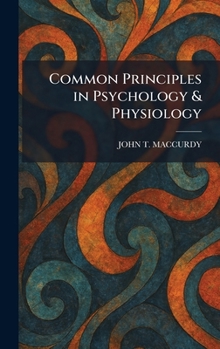
Common Principles in Psychology & Physiology

"Common Principles in Psychology & Physiology" is a profound exploration of the theoretical bridge between mental processes and biological functions. Written by John T. MacCurdy, this work seeks to identify the shared laws that govern both the human psyche and the physiological systems of the body. By challenging the strict dualism often found in early 20th-century science, the author proposes a unified framework where psychological phenomena are understood as continuous with organic life.
The book delves into the nature of behavior, the structure of organic responses, and the fundamental similarities between simple physiological reflexes and complex psychological patterns. MacCurdy offers a rigorous analysis of how life systems maintain a level of consistency across different scales of complexity, providing a holistic view of human nature. This work is an essential resource for those interested in the history of psychology, the origins of neuropsychology, and the evolution of psychopathology. It remains a significant contribution to the study of the brain-mind relationship, emphasizing the continuity of biological principles throughout all levels of human experience.
This work has been selected by scholars as being culturally important, and is part of the knowledge base of civilization as we know it. This work was reproduced from the original artifact, and remains as true to the original work as possible. Therefore, you may see the original copyright references, library stamps (as most of these works have been housed in our most important libraries around the world), and other notations in the work.
This work is in the public domain in the United States of America, and possibly other nations. Within the United States, you may freely copy and distribute this work, as no entity (individual or corporate) has a copyright on the body of the work.
As a reproduction of a historical artifact, this work may contain missing or blurred pages, poor pictures, errant marks, etc. Scholars believe, and we concur, that this work is important enough to be preserved, reproduced, and made generally available to the public. We appreciate your support of the preservation process, and thank you for being an important part of keeping this knowledge alive and relevant.
Customer Reviews
ThriftBooks ® and the ThriftBooks ® logo are registered trademarks of Thrift Books Global, LLC
