


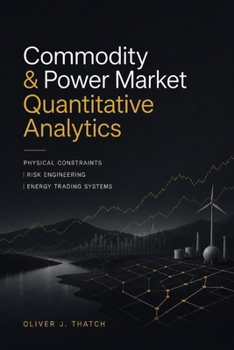
Commodity & Power Market Quantitative Analytics: Physical Constraints, Risk Engineering, and Energy Trading Systems

Bridging the Gap Between Financial Theory and Physical Market Realities
Energy trading operates under strict physical constraints that traditional financial modeling often ignores. In Commodity & Power Market Quantitative Analytics, Oliver J. Thatch delivers a rigorous framework designed specifically for the unique mechanics of power grids, regional commodity hubs, and complex energy derivatives.
This comprehensive volume moves beyond abstract pricing equations to address the actual operational friction faced by quantitative analysts, risk engineers, and trading desks, from grid congestion and non-storable power dynamics to extreme price volatility and spatial basis risk.
Key Topics Covered:
Physical Constraints & Grid Mechanics: Incorporating transmission limits, unit commitment friction, non-storability, and generation dispatch into pricing models.
Quantitative Risk Engineering: Modeling non-Gaussian price distributions, sudden spike risks, negative pricing events, and volumetric uncertainty.
Energy Trading Systems: Constructing robust valuation frameworks for swing options, virtual power plants, spatial basis spreads, and cross-border interconnectors.
Advanced Econometric Methods: Implementing mean-reverting jump-diffusion models, regime-switching techniques, and structural supply-demand curve modeling.
Whether you are building valuation pipelines, optimizing asset dispatch, or managing exposure in volatile prompt markets, this book provides the mathematical foundations and practitioner-focused insights required to engineer resilient trading and risk systems.
Essential reading for Quantitative Analysts, Energy Risk Managers, Commodity Structurers, and Trading Systems Engineers.
Customer Reviews
ThriftBooks ® and the ThriftBooks ® logo are registered trademarks of Thrift Books Global, LLC
