


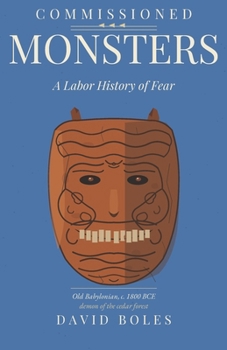
Commissioned Monsters: A Labor History of Fear

A clay head sits behind glass in the British Museum's Mesopotamian galleries. It is roughly four thousand years old, made by an Old Babylonian artisan who modeled features designed to frighten. Someone paid for that mask. Someone wanted that fear. The patron is anonymous, the artisan is anonymous, but the transaction is the beginning of a labor history that runs from Old Babylonian Sippar to twenty-first-century Washington.
Commissioned Monsters: A Labor History of Fear documents the figures political and cultural institutions paid contractors to produce across forty-eight centuries of recorded human history. Heinrich Kramer, who designed the witch in his 1487 inquisitorial manual. Jack Pierce, who built the Frankenstein face at Universal Studios in 1931. Lee Atwater, who delivered Willie Horton to the 1988 Bush campaign. A Reagan-era contractor network that turned a Chicago woman named Linda Taylor into the welfare queen. Prosecutors in the 1989 Central Park case. Victorian penny-press editors who built Whitechapel's Jack the Ripper into a mass-market commercial phantom. An internet folklore community whose Slender Man drove two twelve-year-olds in Waukesha to attempt the murder of their friend in 2014.
Across twenty chapters and twenty case studies, David Boles develops a five-phase lifecycle that traces every commissioned monster from initial design, through release at institutional scale, through maintenance work in court and broadcast and statehouse, through domestication into vampire and zombie and werewolf commercial commodity, and through burial and resurrection in the modern refinanced forms of the Yellow Peril, the Cold War sleeper agent, and the immigrant invader. The book closes with the Last Invoice: the cumulative cost the commissioning labor has charged the populations whose lives it targeted, paid in executions, lynchings, deportations, wrongful incarcerations, and the contemporary mass-violence record.
The book treats monsters as commissioned objects with contractor networks, institutional venues, and cost-paid frameworks. It asks five questions of every figure on the cultural record: who paid for it, who designed it, who maintained its circulation, who benefited from its working career, and what did it cost the populations the figure targeted. A reader who finishes the book carries the five questions. The book hopes the reader will use them.
Related Subjects
History Political Science Politics & Social Sciences Social Science Social SciencesCustomer Reviews
ThriftBooks ® and the ThriftBooks ® logo are registered trademarks of Thrift Books Global, LLC
