


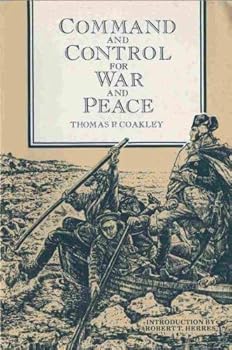
Command and Control for War and Peace


Select Format
Select Condition 
Book Overview
No Synopsis Available.
Format:Paperback
Language:English
ISBN:0160363373
ISBN13:9780160363375
Release Date:February 1992
Publisher:United States Government Printing Office
Length:217 Pages
Weight:0.65 lbs.
Dimensions:0.5" x 5.3" x 8.0"
Related Subjects
HistoryCustomer Reviews
1 rating
Good advice, too bad it wasn't taken
Published by Thriftbooks.com User , 16 years ago
It is not apparent from the title, but "Command and Control for War and Peace" is explicitly aimed at civilians. It also claimed to be the first comprehensive overview of command and control theory when it was published in 1992, Its importance now is that it gives an insight into the misunderstanding of the "force multiplier" concept that, in the hands of America's incompetent civil and military leadership, had such disastrous consequences in Iraq and Afghanistan. But first, it was commendable for the National Defense University to think of giving somebody the time to rethink command and control from general concepts, and perhaps daring to give the assignment to a professor of English (who was also an Air Force officer with operational command experience). At the very least, the result is readable. Coakley does a good job of it, too. While his assignment is smaller, his approach is akin to that taken by Clausewitz: military "philosophizing" with actual battle experiences as a check on fantasizing. Coakley spends much of his space on trying to disabuse readers (who will, despite the invitation to civilians inevitably be mostly professional soldiers or their civilian adjuncts) of what he conceived to be the misunderstandings about command and control up through the first Gulf War. Much of this centers around cautions against assuming command and control is largely a function of technology. "Looking back on America's military calamities of the past 50 years, what's apparent is that in many cases our command and control disasters occurred despite the presence of advanced technology." The rest of the discussion need not be rehearsed here, but what Coakley is writing about was, in fact, treated as important by senior leaders. When Secretary of Defense Donald Rumsfeld talked about "unknown unknowns," he was recalling a seminar he had attended two decades earlier when the influential Pentagon theorist Anthony Oettinger presented his scheme for helping commanders understand the limits of intelligence. It made excellent sense, and the ridicule heaped on Rumsfeld (who deserved ridicule, but not for this) only showed that pundits and reporters are not familiar with the command and control doctrine that is used to run our military operations. Much of the doctrine makes sense, but the reason for emphasizing command and control (which began with President Carter and reached a peak of intensity under President Reagan) has been misunderstood. Superior command and control technology and operational technique can act as a "force multiplier," allowing one commander to achieve success with economy. The notion is no more complicated than Confederate Gen. N.B. Forrest's advice to "get there fustest with the mostest." although Forrest didn't explain how he know where "there" was. Rumsfeld, most prominently, and the entire American high command misunderstood economy of force to mean replacement of force. Claiming (more or less accurately) to have superior com
Copyright © 2026 Thriftbooks.com Terms of Use
| Privacy Policy | Do Not
Sell/Share My Personal Information | Cookie Policy | Cookie Preferences | Accessibility Statement
ThriftBooks® and the ThriftBooks® logo are registered trademarks of Thrift Books Global, LLC
ThriftBooks® and the ThriftBooks® logo are registered trademarks of Thrift Books Global, LLC
