


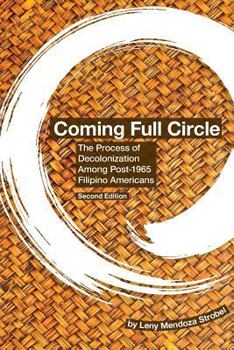
Coming Full Circle: The Process of Decolonization Among Post-1965 Filipino Americans

Select Format
Select Condition 
Book Overview
In this second edition of Coming Full Circle: The Process of Decolonization Among Post-1965 Filipino Americans, Professor EJR David writes a new FOREWORD and the author has a NEW INTRODUCTION.Coming Full Circle is about the healing of the Filipino colonized psyche through the recovery and re-imagination of Filipino identity and culture. It is about the emergence from the 'culture of silence' to critical consciousness that is able to develop new conceptualizations and frameworks about the Filipino American experience.Decolonization is a psychological process that enables the colonized to understand and overcome the depths of alienation and marginalization caused by the psychic and epistemic violence of colonization. Decolonization transforms the consciousness of the colonized through the reclamation of the Filipino cultural self and makes space for the recovery and healing of traumatic memory, and healing leading to different forms of activism. It is an open-ended process. It is a new way of seeing. As a way of healing, it is also a promise and a hope.
Format:Paperback
Language:English
ISBN:1522842373
ISBN13:9781522842378
Release Date:January 2016
Publisher:CreateSpace Independent Publishing Platform
Length:276 Pages
Weight:0.90 lbs.
Dimensions:0.6" x 6.0" x 9.0"
Customer Reviews
2 ratings
mind detox breakthrough for Filipinos
Published by Thriftbooks.com User , 24 years ago
If you ever wanted to know more about certain Filipino quirks such as why there are so many Philippine mestizo movie stars and models ' or why many Filipinos believe that imported or "i-stateside" things are superior'or why there are Filipinos who are embarrassed to say they are Filipino' then this book could help you find out why. "Coming Full Circle" by Leny Strobel talks about the Filipino psychological handicap called colonial mentality. Better yet, this book tells a Filipino probable ways that one could cure colonial mentality in oneself if they ever chose to. For a Filipino, reading this book (even just parts at a time) can already help their mind detoxify from colonial psychological rubbish.This is a brave book of a Filipino woman's study and exploration of the phenomenon of Filipino's lack of ethnic pride and the inability to articulate or manifest a strong sense of ethnic identity (colonial mentality) and the process of unlearning it (decolonization). The book is a ground breaking, significant contribution to Filipino community because it is a lucid articulation of the predicament and struggle within the process of finding Filipino identity---individual and collective, whole and healed.Both Philippine and U.S. educational systems do not tell a complete story of U.S. colonial history in the Philippines, but by reading this book, I finally came to know more about it. Just a note, the Philippines was also colonized by Spain, but this book does not cover Spanish colonial history and influences. Still, this book is enough to better understand how colonial mentality came about. The book gives concrete facts and terms to connect to what I have already been going through in my life when I tackled thoughts and concepts of colonial mentality, ethnic pride and individuality on my own terms since my Philippine university days in the 80s. I believe that many other Filipinos will also be able to make a few connections with the information and narratives in this book.Leny Strobel's work is both scholarly and intuitive. It not only explains and informs on an academic level, but it also contains insightful thoughts, honest feelings and personal stories. The book illustrates expressions and appearances of colonial mentality through accounts of the author's and that of others. I found many of these people's experiences similar with my own and with Filipinos both in the U.S. and the Philippines.Most significantly, the book talks about the process of decolonization not only in theory but also actual practice. Strobel recognizes that decolonization is a progression of healing and in the book we read that it is "a process of learning to love one's self again' of learning to face the truth and learning to tell the truth'learning to draw up the powers from the deep like before' going back to our roots'" and more. She cites ways for such wholistic self-recovery and discusses what she and the field study participants acted out and how these actions gradually pushe
Decolonization Doesn't Just Happen.
Published by Thriftbooks.com User , 25 years ago
Filipino Americans carry within themselves their colonial past, in the form of colonial mentality, a collective term for certain types of thought processes, attitudes, behaviour, beliefs, and misinformation. In the concrete case of the Philippines, the brutal military conquest of the country and its economic exploitation by the US was accompanied by what we now recognize as psychological warfare, or indoctrination, that helped shape this colonial mentality. The process of reversing it is named decolonization by Strobel, who appears to be the first writer to have recognized exactly how the process works in individuals. Decolonization is not spontaneous. It can only be individually accomplished by a conscious sustained effort, as explained and described in detail, with numerous examples, in this valuable volume. There is no heavy rhetoric here, no fist shaking, no fancy political polemics, just patient explanations. Most Filipino Americans have the potential to decolonize themselves, and to thereby enhance their personal dignity, self-esteem, and understanding of their true place in the world, and this is the essential guidebook.
Copyright © 2026 Thriftbooks.com
Terms of Use | Privacy Policy | Do Not Sell/Share My Personal Information | Cookie Policy | Cookie Preferences | Accessibility Statement
ThriftBooks ® and the ThriftBooks ® logo are registered trademarks of Thrift Books Global, LLC
ThriftBooks ® and the ThriftBooks ® logo are registered trademarks of Thrift Books Global, LLC
