


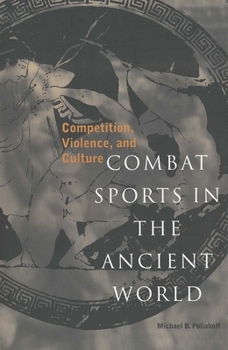
Combat Sports in the Ancient World: Competition, Violence, and Culture


Select Format
Select Condition 
Book Overview
A leading authority on classical games here provides a comprehensive study of the practice of combat sports in the ancient civilizations of Greece, Rome, and the Near East. Describing and analyzing the sports of boxing, wrestling, stick-fighting, and pankration, Michael B. Poliakoff discusses such topics as the function of competition and violent games in ancient society; on the social background of the participants, showing the broad spectrum of Greek athletic personnel; on the significance of the appearance of combat sport in myth and literature; and on the alleged cultic functions of the ancient combat sports. The book is copiously illustrated with photographs of numerous objects rarely or never before published.
Format:Paperback
Language:English
ISBN:0300063121
ISBN13:9780300063127
Release Date:April 1995
Publisher:Yale University Press
Length:220 Pages
Weight:0.85 lbs.
Dimensions:0.7" x 6.0" x 8.9"
Customer Reviews
5 ratings
Great Book!!!!!!
Published by Thriftbooks.com User , 18 years ago
Well to start off im 18 and HATE READING (as does everyone in my generation) and from the way that this book was layed out I thought it was the average encyclopidia style book that is boring as hell and that only Stephen FRICKEN Hawking could only understand. I did order it seeing from the last 4 reviews and found out that this book is actually very informative and very well written to keep your attention regardless if you hate reading or not. Filled with greek storys and in formation on pankration, boxing and wrestling. And little things about them that will make you sound smart LOL. I even used this book as my main source for my essay in college and got a A to be honest this was my only source really the other 5 books were the encyclopidia style that looked like they were written in greek rather than be on the damn topic. Anyways really good book definitly would say buy it though there is only like 3 pages on stick fighting so if your looking for that you might be a little disapointed but none the less this book is to good to not get.
An Excellent Survey of Classical Martial Arts
Published by Thriftbooks.com User , 19 years ago
Poliakoff gives a thorough overview of the three combat sports of the ancient Olympics (wrestling, boxing, & pankration), their rules, the training involved, and the attitudes of the Ancients towards those sports. He speaks briefly of Egyptian stick fighting, but the dearth of ancient literature on the subject means he can treat it only superficially. In addition to describing the sports, Poliakoff gives biographies of some of the more famous practitioners and voices some opinions about the usefulness of combat sports to the body politic, especially in the field of athletics. In his exposition, Poliakoff sometimes dismisses as fantastical legend some feats which are achievable by well trained athletes. For example, he expresses grave doubts about the tradition that the wrestler Milo of Kroton could lift and carry a bull. In the mid-20th century there was a carnival performer, H.E. Mann, who lifted and carried a bull as a part of his act. Mann's act was inspired by Milo. Poliakoff neglects to mention that Milo is credited as the father of "progressive resistance" weight training. Milo began with a calf and lifted it daily until it became full grown. H.E. Mann trained for his carnival act exactly as Milo did, beginning with a calf and lifting it daily until it became full grown. One of the USA's earliests vendors of weight training equipment was the Milo Barbell Company. Poliakoff takes a dim view of the savagery involved in ancient combat sports and sees no correlation between the combat sports and actual military service. Although Poliakoff seeks to show that excellent combat athletes make poor soldiers, he does cite numerous counter examples to his position. It seems ancient Greek history is full of individuals who distinguished themselves both in the games and on the battlefield. Notwithstanding Poliakoff's anti-combat-sports agenda, the book is an informative and enjoyable reading experience.
Nothing New Under the Sun
Published by Thriftbooks.com User , 20 years ago
Fans of modern day Pankration, as in the UFC, Pride and other such events, will be fascinated to read of the close parallels between the ancient and modern versions in terms of technique, match style as well as audience reception. Many of the same issues facing the sport today were dealt with by the ancients. More important perhaps is what is revealed regarding the importance and effectiveness of combat sports outside the competitive arena. Poliakoff quotes Homer, Alexander and others to make the point that boxing, wrestling and pankration may not be so effective in producing an effective warrior. Alexander, for instance, didn't approve of boxing and wrestling but did favor stick fighting. Champion athletes in the Iliad are cowardly in battle. The Romans blame the Greek love of "games" on their decline. Scholarly, readable, relevant.
"...victory...gained in blood..."
Published by Thriftbooks.com User , 21 years ago
This book effectively shows that ancient sports werealso about the rough and tumble and agony, as wellas the skill, courage, and cleverness. The bookis a complete survey including information aboutancient Mesopotamia and Egypt, but primarily focuseson Greek and Roman sports and venues. As the author, Michael Poliakoff, says in ChapterI, "General Aspects of the Ancient Combat Sports,""Boxing, wrestling, and pankration, a sport thatallowed a variety of unarmed fighting tactics, werethe three important forms of combat sport in the ancient world. *** The element of fighting makescombat sports easy to mark off as a group; moredifficult is settling on a definition of sport ingeneral. I define sport and athletics in this bookas activity in which a person physically competesagainst another in a contest with establishedregulations and procedures, with the immediateobject of succeeding in that contest under criteriafor determining victory that are different from thosethat mark success in everyday life." The chapters of the book are: General Aspects ofthe Ancient Combat Sports/ Wrestling/ Pankration/Stick Fighting/ Boxing/ The Nature and Purpose ofCombat Sport/ The Participants in Greek CombatSport/ Metaphor, Myth, and Reality/ as well asan Appendix titled "Combat Sport, Funeral Cult,and Human Sacrifice." The book is very well illustrated throughoutthe text with photographs from vases, drinkingcups, statues, Egyptian wall paintings andsculptures, a photo of a Greek wrestlingmanuscript, and a modern photo of Nuba wrestlersin the Sudan. Each of the chapters is also divided into interesting sub-sections. In Chapter VI, forinstance, the sub-sections are: The Problem ofAthletic Violence/ The Nature of Ancient Criticism/Military Consideratons/ Military Critics/ An Agonistic Society/ Sport in Other Cultures: TheContrast with Greece/ and, Greek Agon and SocialNeed. Each chapter starts with a highly interestingand engrossing introductory paragraph. From the"Wrestling" chapter comes this: "Wrestling appealeddeeply to the ancients. Though far from being agentle sport, it is substantially less violent andinjurious than the other two combat sports: it pitsone man against another in a close struggle thatmaximizes the role of skill and science. In amanner that encourges wide participation, it testsan array of martial virtues: cunning, boldness,courage, self-reliance, and perseverance." -- Robert Kilgore.
Very good historical review of "Combat Sports." back then.
Published by Thriftbooks.com User , 29 years ago
I give this book an 8 because it had a vlaue to me beyond what normally would be sought. I am a fan of today's comabt sports, the UFC, Pancrase, Vale Tudo, etc... This was the beginning and it was facinating to me. I had read about Pancration, Boxing and Wrestling in ancient times in another book (which this list doesn't have access to I notice...) called "Living in teh Combat Zone" by Rick Renner - published by Pillar Books of Tulsa OK. It's A Christian book, but has tremendous historical value as well. Joe
Copyright © 2025 Thriftbooks.com
Terms of Use | Privacy Policy | Do Not Sell/Share My Personal Information | Cookie Policy | Cookie Preferences | Accessibility Statement
ThriftBooks ® and the ThriftBooks ® logo are registered trademarks of Thrift Books Global, LLC
ThriftBooks ® and the ThriftBooks ® logo are registered trademarks of Thrift Books Global, LLC
