


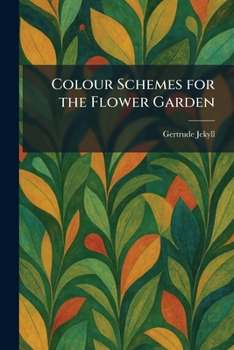
Colour Schemes for the Flower Garden

"Colour Schemes for the Flower Garden" is a seminal work by the influential horticulturist and garden designer Gertrude Jekyll. In this classic volume, Jekyll presents her sophisticated philosophy on the use of color within the landscape, treating the garden as a living canvas. The text provides a detailed exploration of how to arrange flowers and foliage to create harmonious and visually striking effects throughout the seasons. Jekyll's approach focuses on the deliberate grouping of plants based on their hue, saturation, and texture, advocating for the creation of "pictures" within the garden.
The book covers various aspects of garden planning, including the design of herbaceous borders, the arrangement of spring and summer gardens, and the strategic use of gray and gold foliage. Jekyll's insights into the relationship between light and color remain foundational for both amateur gardeners and professional landscape architects. Her expertise in combining botany with an artistic sensibility is evident in her practical advice on plant selection and placement. "Colour Schemes for the Flower Garden" stands as an enduring guide for anyone seeking to master the art of garden composition, offering timeless principles that continue to influence contemporary horticultural practices.
This work has been selected by scholars as being culturally important, and is part of the knowledge base of civilization as we know it. This work was reproduced from the original artifact, and remains as true to the original work as possible. Therefore, you may see the original copyright references, library stamps (as most of these works have been housed in our most important libraries around the world), and other notations in the work.
This work is in the public domain in the United States of America, and possibly other nations. Within the United States, you may freely copy and distribute this work, as no entity (individual or corporate) has a copyright on the body of the work.
As a reproduction of a historical artifact, this work may contain missing or blurred pages, poor pictures, errant marks, etc. Scholars believe, and we concur, that this work is important enough to be preserved, reproduced, and made generally available to the public. We appreciate your support of the preservation process, and thank you for being an important part of keeping this knowledge alive and relevant.
Customer Reviews
ThriftBooks ® and the ThriftBooks ® logo are registered trademarks of Thrift Books Global, LLC
