


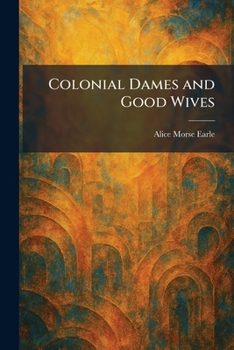
Colonial Dames and Good Wives

"Colonial Dames and Good Wives" is a captivating exploration of the daily lives, roles, and societal contributions of women in early American history. Alice Morse Earle provides a detailed window into the domestic and social landscape of the colonial era, offering a narrative that vividly recreates the challenges and triumphs of women who helped shape the foundations of the United States.
The book delves into a variety of fascinating topics, including courtship and marriage customs, domestic arts, and the education of children. It also highlights the lives of notable "colonial dames" and the "good wives" whose resilience and industry were essential to the survival and growth of early settlements. From the arduous tasks of pioneer housewives to the refined social circles of the colonial elite, Earle examines how these women navigated the constraints of their time while exerting significant influence within their families and communities.
This classic work remains an invaluable resource for readers interested in women's history, social customs, and the cultural heritage of early America. By documenting the often-overlooked experiences of colonial women, the author ensures their vital place in the historical record is preserved and celebrated.
This work has been selected by scholars as being culturally important, and is part of the knowledge base of civilization as we know it. This work was reproduced from the original artifact, and remains as true to the original work as possible. Therefore, you may see the original copyright references, library stamps (as most of these works have been housed in our most important libraries around the world), and other notations in the work.
This work is in the public domain in the United States of America, and possibly other nations. Within the United States, you may freely copy and distribute this work, as no entity (individual or corporate) has a copyright on the body of the work.
As a reproduction of a historical artifact, this work may contain missing or blurred pages, poor pictures, errant marks, etc. Scholars believe, and we concur, that this work is important enough to be preserved, reproduced, and made generally available to the public. We appreciate your support of the preservation process, and thank you for being an important part of keeping this knowledge alive and relevant.
Customer Reviews
ThriftBooks ® and the ThriftBooks ® logo are registered trademarks of Thrift Books Global, LLC
