


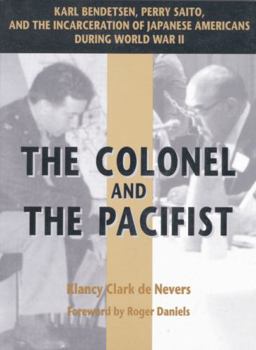
The Colonel and the Pacifist: Karl Bendetsen-Perry Saito and the Incarceration of Japanese Americans During World War II


Executive Order 9066. In February 1942, ten weeks after the Japanese attack on Pearl Harbor, President Franklin D. Roosevelt put his signature to a piece of paper that allowed the forced removal of Americans of Japanese ancestry from their West Coast homes, and their incarceration in makeshift camps. Those are the facts. But two faces emerge from behind these facts: Karl R. Bendetsen, the Army major who was promoted to full colonel and placed in charge of the evacuation after formulating the concept of 'military necessity, ' and who penned the order Roosevelt signed, and Perry H. Saito, a young college student, future Methodist minister, and former neighbor from Bendetsen's hometown of Aberdeen, Washington who was incarcerated in Tule Lake Relocation Camp. The Colonel and the Pacifist tells the story of two men caught up in one of the most infamous episodes in American history. While they never met, Bendetsen and Saito's lives touched tangentially--from their common hometown to their eventual testimony during the 1981 hearings of the Commission on the Wartime Relocation and Internment of Civilians. In weaving together these contrasting stories, Klancy Clark de Nevers not only exposes unknown or little known aspects of World War II history, she also explores larger issues of racism and war that resonate through the years and ring eerily familiar to our post-9/11 ears.
Format:Paperback
Language:English
ISBN:0874807891
ISBN13:9780874807899
Release Date:May 2004
Publisher:University of Utah Press
Length:382 Pages
Weight:1.43 lbs.
Dimensions:1.0" x 6.2" x 8.9"
Age Range:18 years and up
Grade Range:Postsecondary and higher
Customer Reviews
2 ratings
Formation of Executive order 9066
Published by Thriftbooks.com User , 17 years ago
1. In 1942 the Office of the Attorney General was Francis Biddle and James Rowe, the FBI director was Edgar Hoover of the Justice department, and John McCloy, General Gullion, and Bendetsen of the War department. 2. Hoover attacked the military intelligence as exhibit signs of hysteria and lack of judgment. 3. A heated debate emerged between the Justice Department and the War Department. Biddle said he opposed the mass evacuation. Gullion and DeWitt said the situation was precarious and the Japanese had to be removed. Biddle turmoil arose from a pull between the safety of the country and the fundamental protections allotted by the constitution. The War department said they would support evacuation upon DeWitt's recommendation. However, McCloy was concerned that DeWitt did not have enough grounds to justify a movement of this sort. 4. McCloy said that after the compulsory expulsion of Japanese citizens that some might be permitted to return. 5. What were DeWitts issues? DeWitt said, "I'm only concerned with getting them away from around these aircraft factories and other places." McCloy identified a few key installations: Consolidated-Vultee plant in San Diego, the Lockheed and Martin plants in Los Angeles, and Boeing in Seattle. However, protection of critical facilities did not require mass evacuation. More soldier were required to enforce internment than protection of critical faciltiies. 6. Bendetsen wrote a paper, Feb, 1942, subject, "Alien enemies on the West Coast", he equated the enemy problem on the West coast with the sabotage problem. Bendetsen argued large concentrations of Japanese in close proximity to strategically critical areas threatened US security. However, there was no evidence of sabotage or a raid being attempted by West Coast Japanese. 2/3 of the 110,000 evacuees were US citizens, loyal to America, not Japan. 7. Bendetsen created the idea of designated military areas that surrounded vital installations in the Western Defense Command and exclude all the Japanese as a measure of military necessity. Free citizen movement for relocation was not allowed and imprisonment resulted, a constitutional crisis. The War department stated that exclusion of the Japanese from a military area did not constitute a "arbitrary class discrimination". However, if this class of people were black, the US supreme court would have to disagree based on the history of segregation. 8. General Gullion sent a memorandum to McCloy telling him the danger of Japanese inspired sabotage was great. Gullion, DeWitt, and Bendetsen shared the same fatalistic vision. 9. By mid-febuary, the FBI had arrested 2,192 Japanese aliens, 1,393 Germans, and 264 Italians. Hoover was satisified that no further arrests were required. When asked about executive order 9066, he stated that no case had been made to justify mass evacuation for security reasons. 10. The book, "Valor of Ignorance" by Homer Lea predicted thirty years prior Pearl Harbor changes in pow
A Cautionary Tale
Published by Thriftbooks.com User , 20 years ago
The Colonel and the Pacifist deals with a shameful part of the American record: the forced relocation of West Coast Japanese-Americans (many of whom were U.S. citizens) after the Japanese attack on Pearl Harbor. The author Klancy Clark deNevers puts a human face on these events by describing how the Colonel, Karl Bendetsen, promoted, engineered, and oversaw the program and how it affected the life of one of the Japanese-Americans, pacifist Perry Saito. Both protagonists grew up in Ms deNevers hometown of Aberdeen, Washington. From there their lives diverged. When Ms deNevers began her painstaking research she may have had little idea how relevant the issues raised would be in a post 9/11 United States. Many events of over sixty years ago have present day equivalents: racial prejudice and profiling, unwarranted detainments, suspects held incommunicado, fruitless FBI searches etc. This well told story can serve as a cautionary tale.
Copyright © 2026 Thriftbooks.com Terms of Use
| Privacy Policy | Do Not
Sell/Share My Personal Information | Cookie Policy | Cookie Preferences | Accessibility Statement
ThriftBooks® and the ThriftBooks® logo are registered trademarks of Thrift Books Global, LLC
ThriftBooks® and the ThriftBooks® logo are registered trademarks of Thrift Books Global, LLC
