


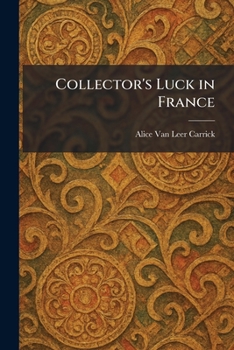
Collector's Luck in France

Select Format
Select Condition 
Book Overview
"Collector's Luck in France" is an engaging and informative blend of travel narrative and antique collector's guide. Written by the esteemed authority Alice Van Leer Carrick, this work chronicles her enthusiastic search for treasures across the French landscape in the early twentieth century. From the celebrated flea markets of Paris to hidden shops in the countryside, Carrick captures the thrill of the hunt and the joy of discovery.
The book serves as a sophisticated guide for those interested in the world of curios, furniture, glassware, and historical artifacts. Carrick provides readers with practical advice on navigating French markets, evaluating finds, and understanding the cultural history behind various collectibles. Her prose is both witty and instructional, offering a vivid portrait of post-war France through the lens of a dedicated connoisseur. Whether exploring the markets of Paris or scouring provincial boutiques, "Collector's Luck in France" remains a delightful resource for historians, travelers, and antique enthusiasts alike, preserving a timeless appreciation for craftsmanship and the stories embedded in everyday objects.
This work has been selected by scholars as being culturally important, and is part of the knowledge base of civilization as we know it. This work was reproduced from the original artifact, and remains as true to the original work as possible. Therefore, you may see the original copyright references, library stamps (as most of these works have been housed in our most important libraries around the world), and other notations in the work.
This work is in the public domain in the United States of America, and possibly other nations. Within the United States, you may freely copy and distribute this work, as no entity (individual or corporate) has a copyright on the body of the work.
As a reproduction of a historical artifact, this work may contain missing or blurred pages, poor pictures, errant marks, etc. Scholars believe, and we concur, that this work is important enough to be preserved, reproduced, and made generally available to the public. We appreciate your support of the preservation process, and thank you for being an important part of keeping this knowledge alive and relevant.
Customer Reviews
ThriftBooks ® and the ThriftBooks ® logo are registered trademarks of Thrift Books Global, LLC
