


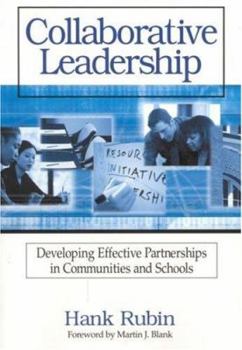
Collaborative Leadership: Developing Effective Partnerships in Communities and Schools
No Customer Reviews

Select Format
Select Condition 
Book Overview
"This important book identifies the teachable characteristics of collaborative leadership, and offers sound guidance about how to develop them in yourself and others. I believe this candid and practical work can have a profoundly positive impact on all who study it."
--Bob Barkley, Executive Director (Retired)
Ohio Education Association
"Readers will find in Hank Rubin′s work both a useful theoretical framework and very practical advice for creating and sustaining collaboratives that foster improved student learning. This book provides insights for anyone engaged in collaborative efforts to improve student achievement--whether you are working at the school, local community, state, or national level."
--Judy Wurtzel, Executive Director
Learning First Alliance
Learn how to maximize collaboration for the realization of goals
--Bob Barkley, Executive Director (Retired)
Ohio Education Association
"Readers will find in Hank Rubin′s work both a useful theoretical framework and very practical advice for creating and sustaining collaboratives that foster improved student learning. This book provides insights for anyone engaged in collaborative efforts to improve student achievement--whether you are working at the school, local community, state, or national level."
--Judy Wurtzel, Executive Director
Learning First Alliance
Learn how to maximize collaboration for the realization of goals
By cultivating skills of relationship building and relationship management, educators, as well as community, and government leaders, can empower themselves and their institutions with the tools needed to achieve their missions and create positive systemic change. In his provocative book, visionary Hank Rubin goes beyond the traditional roles of school, community, and government leaders and gives readers usable, successful tools and models of collaboration that can boost their performance and capacity. Key features of this insightful guide for practitioners and students include:
Straightforward discussion of 24 specific skills and attributes that foster successful collaboration Exploration of the 12 phases of collaboration, including a checklist and practical framework 7 essential characteristics of effective collaborative leaders Definitions and discussions of the contexts and purposes of collaboration that are practical and thought-provokingCollaborative Leadership is an important contribution to the growing demand for strategic alliances in education, community organizations, social service agencies, government and political offices, philanthropies, and businesses. The author asserts--and provides compelling illustrative evidence--that collaboration skills are essential tools for leaders hoping to have long-lasting systemic impact on school communities.Format:Paperback
Language:English
ISBN:0761978925
ISBN13:9780761978923
Release Date:May 2002
Publisher:Corwin
Length:136 Pages
Weight:0.70 lbs.
Dimensions:9.8" x 0.5" x 6.8"
Customer Reviews
0 rating
Copyright © 2026 Thriftbooks.com
Terms of Use | Privacy Policy | Do Not Sell/Share My Personal Information | Cookie Notice | Cookie Preferences | Accessibility Statement
ThriftBooks ® and the ThriftBooks ® logo are registered trademarks of Thrift Books Global, LLC
ThriftBooks ® and the ThriftBooks ® logo are registered trademarks of Thrift Books Global, LLC
