


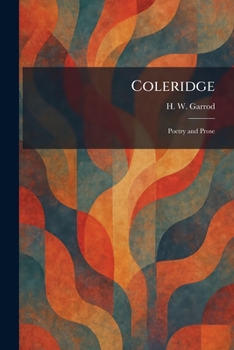
Coleridge: Poetry and Prose

"Coleridge; Poetry and Prose" offers a comprehensive overview of the literary genius of Samuel Taylor Coleridge, one of the most influential figures of the Romantic movement. This volume, curated by scholar H.W. Garrod, brings together a selection of Coleridge's most celebrated verse alongside his insightful prose writings. Readers will find the haunting narratives of "The Rime of the Ancient Mariner" and the evocative fragments of "Kubla Khan," works that redefined the possibilities of the English language through their supernatural themes and rhythmic innovation.
Beyond his poetry, this collection provides access to Coleridge's profound philosophical and critical thought. His prose selections highlight his role as a pioneering literary critic and a thinker who deeply influenced the development of aesthetic theory. From the visionary imagination displayed in his verse to the intellectual rigour of his essays, this compilation showcases the breadth of a writer who bridged the gap between the emotive power of Romanticism and the analytical depth of modern criticism. "Coleridge; Poetry and Prose" remains an essential resource for those seeking to understand the foundational pillars of 19th-century literature and the enduring legacy of a master stylist.
This work has been selected by scholars as being culturally important, and is part of the knowledge base of civilization as we know it. This work was reproduced from the original artifact, and remains as true to the original work as possible. Therefore, you may see the original copyright references, library stamps (as most of these works have been housed in our most important libraries around the world), and other notations in the work.
This work is in the public domain in the United States of America, and possibly other nations. Within the United States, you may freely copy and distribute this work, as no entity (individual or corporate) has a copyright on the body of the work.
As a reproduction of a historical artifact, this work may contain missing or blurred pages, poor pictures, errant marks, etc. Scholars believe, and we concur, that this work is important enough to be preserved, reproduced, and made generally available to the public. We appreciate your support of the preservation process, and thank you for being an important part of keeping this knowledge alive and relevant.
Customer Reviews
ThriftBooks ® and the ThriftBooks ® logo are registered trademarks of Thrift Books Global, LLC
