


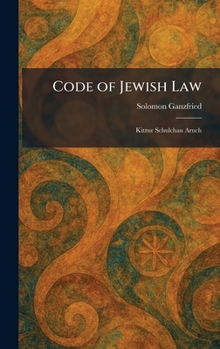
Code of Jewish Law: Kitzur Schulchan Aruch

"Code of Jewish Law (Kitzur Schulchan Aruch)" is an essential and comprehensive guide to the daily practice and ethical life of the Jewish faith. Authored by Rabbi Solomon Ganzfried, this influential work serves as a practical compendium of Halacha (Jewish law), designed to be accessible to the layperson. It distills the vast complexities of the broader legal tradition into a clear, concise manual that covers every aspect of religious life, from morning prayers and dietary restrictions to the observance of the Sabbath and festivals.
The work is highly regarded for its systematic approach to traditional observance, providing authoritative guidance on communal and individual conduct. By focusing on the laws most applicable to daily living, the text offers a window into the structured spiritual life of the Jewish community. "Code of Jewish Law (Kitzur Schulchan Aruch)" remains a cornerstone of Jewish scholarship and education, valued for its historical significance and its enduring role as a primary reference for those seeking to live in accordance with Jewish tradition and law. Its clear instructions and breadth of topics make it an indispensable resource for students of theology and practitioners alike.
This work has been selected by scholars as being culturally important, and is part of the knowledge base of civilization as we know it. This work was reproduced from the original artifact, and remains as true to the original work as possible. Therefore, you may see the original copyright references, library stamps (as most of these works have been housed in our most important libraries around the world), and other notations in the work.
This work is in the public domain in the United States of America, and possibly other nations. Within the United States, you may freely copy and distribute this work, as no entity (individual or corporate) has a copyright on the body of the work.
As a reproduction of a historical artifact, this work may contain missing or blurred pages, poor pictures, errant marks, etc. Scholars believe, and we concur, that this work is important enough to be preserved, reproduced, and made generally available to the public. We appreciate your support of the preservation process, and thank you for being an important part of keeping this knowledge alive and relevant.
Customer Reviews
ThriftBooks ® and the ThriftBooks ® logo are registered trademarks of Thrift Books Global, LLC
