


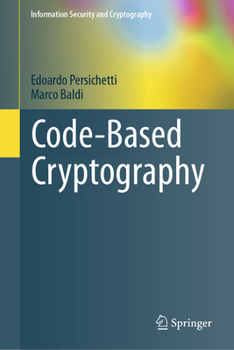
Code-Based Cryptography (Information Security and Cryptography)

Almost half a century after McEliece proposed the first code-based cryptosystem, the field has reached maturity, and is now a major player in post-quantum standardization. This volume presents a wide view of the whole landscape, in a single unified treatment.
The book develops code-based cryptography starting from its fundamental principles and follows it all the way to the schemes now entering deployment. The opening chapters are designed to build the required background in both cryptography and coding theory, so that no prior familiarity with either is assumed. The treatment then proceeds through the main paradigms for encryption/key transport and signatures. Each chapter closes with a detailed presentation of the corresponding modern scheme, selected among the various candidates to the NIST's Post-Quantum Cryptography (PQC) standardization effort.All schemes are described in a unified and simplified notation and accompanied by parameter sets, data sizes and timings.
Topics and features:
-Surveys various code families proposed for cryptographic use, from popular ones such as Goppa and MDPC codes, to various unsuccessful attempts
-Reports parameters, key and ciphertext sizes and cycle counts for every modern scheme under a single, explicitly stated measurement convention
-Covers the most recent cryptanalysis, including the square-code and quadratic-form distinguishers for Goppa codes and the syzygy distinguisher
-Gives self-contained descriptions of the decoding algorithms the schemes depend on, including Patterson, alternant and bit-flipping algorithms
-Follows the NIST and ISO standardization processes, explaining why individual schemes were selected, advanced or set aside
Aimed primarily at researchers and graduate students in cryptography, the book assumes only elementary linear algebra and is suited both to self-study and to a graduate course. It will equally serve researchers and graduate students in coding theory looking for an entry point into the cryptographic applications of their field, as well as implementers and security engineers who need a principled account of the schemes now entering standards.
Marco Baldi is Associate Professor in the Department of Information Engineering at Universit Politecnica delle Marche, Ancona, Italy.Edoardo Persichetti is full Professor in the Department of Mathematics and Statistics at Florida Atlantic University, Boca Raton, FL, USA.
Customer Reviews
ThriftBooks ® and the ThriftBooks ® logo are registered trademarks of Thrift Books Global, LLC
