


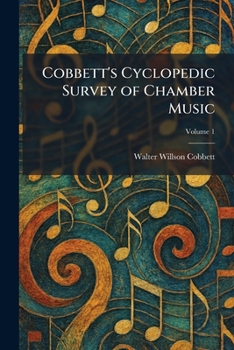
Cobbett's Cyclopedic Survey of Chamber Music

Select Format
Select Condition 
Book Overview
"Cobbett's Cyclopedic Survey of Chamber Music" stands as one of the most comprehensive and authoritative reference works ever compiled on the subject of chamber music. This first volume of the monumental survey provides an exhaustive exploration of the genre, offering detailed entries on composers, specific musical compositions, and the historical development of small-ensemble performance. Compiled and edited by Walter Willson Cobbett, a passionate advocate for the art form, the work reflects a deep scholarly commitment to documenting the vast repertoire of string quartets, trios, sonatas, and other chamber configurations.
The survey is distinguished by its blend of technical analysis and critical appreciation, making it an invaluable resource for musicians, historians, and enthusiasts alike. It covers a diverse array of international composers, ranging from established masters to then-contemporary figures, providing insights into their stylistic contributions and the structural nuances of their works. With its rigorous attention to detail and its celebration of the intimacy and complexity of chamber music, "Cobbett's Cyclopedic Survey of Chamber Music" remains a foundational text in musicology, preserving the legacy of a vital musical tradition.
This work has been selected by scholars as being culturally important, and is part of the knowledge base of civilization as we know it. This work was reproduced from the original artifact, and remains as true to the original work as possible. Therefore, you may see the original copyright references, library stamps (as most of these works have been housed in our most important libraries around the world), and other notations in the work.
This work is in the public domain in the United States of America, and possibly other nations. Within the United States, you may freely copy and distribute this work, as no entity (individual or corporate) has a copyright on the body of the work.
As a reproduction of a historical artifact, this work may contain missing or blurred pages, poor pictures, errant marks, etc. Scholars believe, and we concur, that this work is important enough to be preserved, reproduced, and made generally available to the public. We appreciate your support of the preservation process, and thank you for being an important part of keeping this knowledge alive and relevant.
Customer Reviews
ThriftBooks ® and the ThriftBooks ® logo are registered trademarks of Thrift Books Global, LLC
