


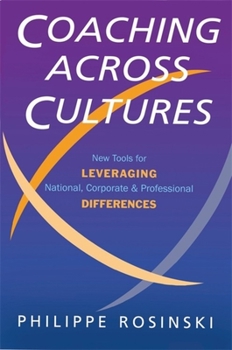
Coaching Across Cultures: New Tools for Levereging National, Corperate and Professional Differences

Select Format
Select Condition 
Book Overview
"Philippe Rosinski is a leader in the coaching field. Coaching Across Cultures reveals his pioneering multi-cultural approach and innovative global perspective. His book is a treasure for anyone eager to learn how to effectively facilitate human fulfillment and responsible growth." - Laura Berman Fortgang, Author of Take Yourself to the Top and Living Your Best LifeAs coaches and clients increasingly realize, the demands of business mean that it is now vital to integrate, understand and leverage cultural differences across countries and corporations. Coaching Across Cultures bridges the gap between coaching and interculturalism.
Format:Paperback
Language:English
ISBN:1857883012
ISBN13:9781857883015
Release Date:January 2003
Publisher:John Murray Business Academic
Length:228 Pages
Weight:1.18 lbs.
Dimensions:1.1" x 5.9" x 9.1"
Customer Reviews
4 ratings
Valuable information and new perspectives for global coaches and business leaders
Published by Thriftbooks.com User , 17 years ago
Philippe Rosinski's book is essential reading not only for global coaches but also for corporate leaders and business professionals who interact with diverse customers, clients and colleagues. The book provides a comprehensive overview of the diversity of cultural orientations, as well as specific tools and recommendations for broadening and leveraging different cultural orientations in the workplace. The centerpiece of the book is a comprehensive model, The Cultural Orientations Framework, which provides a structured format for identifying, assessing, developing and leveraging cultural differences. This model can readily be implemented in the workplace, serving as an objective tool for raising an executive's awareness regarding his/her cultural orientation blind spots. As an executive coach working primarily with American executives who are focused on increasing the breadth and flexibility of their cultural orientations, I have found this book to be a valuable resource for enhancing the cross-cultural capabilities of global executives.
Cross-Cultural Understanding for Coaches
Published by Thriftbooks.com User , 20 years ago
This is the first, and currently only, book on coaching cross-culturally. The author brings the multifaceted perspective of culture into the coaching equation. The book starts with an introduction to coaching and culture and then goes in depth in cultural perspectives. The author wraps up the book with a couple chapters integrating all this into coaching practice. Coaching is defined as "the art of facilitating the unleashing of people's potential to reach meaningful, important objectives" (page 4). Surprisingly there is nothing distinctly cross-cultural in the definition. Such as "the art of facilitating in culturally relevant ways the unleashing of people's potential..." This definition could come from any book on coaching. Culture is defined broadly to include not just nations and peoples, but corporate culture as well. The real meat of the book is the second section, nearly half the text. The author presents a series of Cultural Orientations each with tools for how to assess them through coaching. Orientations such as a sense of power and responsibility, time, identity and purpose, organization and communication each have a chapter devoted to them. The author begins each chapter with a presentation of the various cultural perspectives on the Orientation, for example, concerning time there are grids of scarce or plentiful; one activity at a time or multiple tasks; and past, present or future orientation. The author presents a tool for the coach to understand the client's orientation, and for the client (and teammates) to understand himself or herself. The final section is a synthesis of the theory into practice. The author illustrates how he uses his detailed Cultural Orientation grid during coaching sessions. This book is helpful for those interested in the cross-cultural issues. The book gets a bit lost in trying to reach a wide audience by focusing on at least three audience needs: skills for coaching people of other cultures, cross-cultural team awareness, and personal cultural awareness. The niche this book best fits would be a multicultural team trying to understand each other and how a team leader might coach them through that process of understanding.
STERN'S MANAGEMENT REVIEW RATES THIS BOOK EXCELLENT!
Published by Thriftbooks.com User , 22 years ago
The book is not solely dedicated to the international arena but for everyone who works with people from different organizations and backgrounds. The author's aim is to raise the level of awareness of cultural orientations and suggests how to use differences constructively. The book breaks out of the usual confines of cultural assumptions to find creative solutions. It introduces coaching and cross-cultural concepts, provides a framework for integrating coaching and cultural perspectives, and examines numerous cultural orientations. Rosinski presents a Culture Orientations Framework to assess and profile culture, and a Global Scorecard to help set targets at all levels. Chapters discuss how to leverage power and responsibility, time management, identity and purpose, organizational arrangements, notions of territory and boundaries, communication patterns, and modes of thinking. This is a very thoughtful treatment of an unusual and highly important subject.
Don't bother if you ONLY deal with people JUST like you.
Published by Thriftbooks.com User , 22 years ago
Let me be clear, I don't finish reading books these days unless they are good and I certainly don't bother writing reviews unless I think the book is top notch. So it is a pretty safe bet that if you like any of the other books that I have reviewed, you will like this one.Coaching Across Cultures is another one of those - must have books - for any serious coach working with professionals. Even if you are not interested in an international practice, (and who isn't) this book still is required reading. The book is really about understanding and integrating our differences. Rosinski who lives currently in Belgium, is an Engineer and a MCC by training who has worked in Silicon Valley.The book is a bit of a smorgasbord. However, it is well designed and packaged so that each section can be considered a self contained component on cultural issues. Part One makes the case for a cultural framework when coaching and points out the dangers of our assumptions and belief systems when working with others of any origin or background. Part Two provides a high level overview of the key components of developing a cross cultural mindset. Although generalized in content, it also provides concrete examples and practical applications of how this plays out in our interactions with others. Part Three is a bit more conceptual and is well suited to those who come from an organizational development perspective. Roskinski has created his own Global Scorecard approach that is tied into his Cultural Orientations Framework. For my reading, it seems thorough, usable and comprehensive.Coaching Across Cultures is well documented with references, a glossary and some interesting appendixes. There is little to find fault. Perhaps that is because, Rosinski himself is careful never to find fault. He is a great diplomat and finds a place for all styles and approaches whether it is the transactional techniques of some North American coaching styles to the transformational style of others.If there is one area that I find a little weak, it is his discussion of self-assessment as a precursor the organizational assessment through his Global Scorecard. Now I am the first to admit that assessments are not only my area of interest, it is my business - so I have a bias. That said, I found Rosinski focus on the tools he prefers (the MBTI specifically) left me with the impression that this is THE tool. I also believe that this was not Roskinki's intention - as he does mention a few others but not some that I would have expected. Now don't get me wrong, I love the MBTI and the others he includes but I thought that at least a few more should have been mentioned or acknowledged.This is a solid, well-written and great new contribution to the field of coaching and working within the global setting. Don't just get this book - read it. I can almost guarantee it will have a positive affect on how you will interact in the future with your clients.
Copyright © 2026 Thriftbooks.com Terms of Use
| Privacy Policy | Do Not
Sell/Share My Personal Information | Cookie Policy | Cookie Preferences | Accessibility Statement
ThriftBooks® and the ThriftBooks® logo are registered trademarks of Thrift Books Global, LLC
ThriftBooks® and the ThriftBooks® logo are registered trademarks of Thrift Books Global, LLC
