


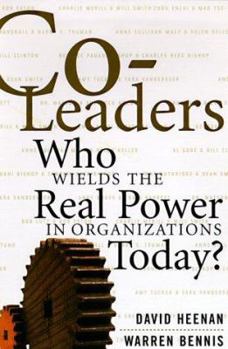
Co-Leaders: The Power of Great Partnerships

Select Format
Select Condition 
Book Overview
"Co-leadership...is a tough-minded strategy that will unleash the hidden talent in any enterprise. Above all, co-leadership is inclusive, not exclusive. It celebrates those who do the real work, not just a few charismatic often isolated leaders who are regally compensated for articulating the organization's vision." -David A. Heenan and Warren Bennis Today's heads of big companies are as recognizable to us as the most popular entertainers or sports stars, but the heart and soul of every organization are those leaders below the CEO. Today's celebrity CEO has become either a figure head or an egomaniac, and often too public a personality to get the real work done. That work is done instead by teams of leaders-exceptional deputies who forge great partnerships to maximize both organizational and personal success. Heenan and Bennis believe we must look beyond the Bill Gateses of the world to understand what makes an organization excel. Written for CEOs, managers, and anyone else interested in modern organizations, this is the first comprehensive study of co-leaders and their often quiet power. Exhaustively researched and illustrated with memorable anecdotes and lively stories, Co-Leaders examines a dozen great partners such as Steve Ballmer of Microsoft, Bob Lutz of Chrysler, Bill Guthridge, coach of the University of North Carolina basketball team, and Anne Sullivan Macy, Helen Keller's teacher. The changing nature of corporate leadership has seen the emergence of a new Silicon Valley model of success, where boss and subordinate seem more like peers with the spotlight on great partnerships. Talent, not title, is the source of power at a growing number of hot high-tech companies. In these collegial, non-hierarchical organizations, today's deputy can become tomorrow's CEO simply by taking his or her breakthrough idea and walking out the door. Good ideas belong, initially at least, to the people who have them, not to the company and not to the boss which is why this new egalitarianism isn't just a matter of style-it's a question of survival. Co-leaders know both the executive and subordinate experience, making them better adapted to the needs of the new millennium where men and women who can command and follow will prove to be the greatest assets of any organization. Co-Leaders is intended for everyone who aspires to make his or her organization great. By showing the enterprise through the eyes of inspired deputies, this book reveals how both organizations and individuals can benefit from a more inclusive, less celebrity-oriented definition of leadership. This groundbreaking book argues for a new paradigm: gifted leaders and their talented co-leaders working together to make their organizations stronger, more nimble, more equitable...and ultimately more successful. David A. Heenan is a trustee of the Estate of James Campbell, one of the nation's largest landowners with assets valued at over $2 billion. A former senior executive with Citicorp and Jardine Matheson, Heenan has served on the faculties of the Wharton School and the Columbia Graduate School of Business. A Wharton Ph.D., he is the author of The New Corporate Frontier and The Re-United States of America, and his articles have appeared in the Harvard Business Review, The Wall Street Journal, and The New York Times. Warren Bennis is Distinguished Professor of Business Administration at the University of Southern California and a consultant to multinational companies and governments throughout the world. Often referred to as "the guru of modern management," he is one of the preeminent authorities on leadership. Author of over a dozen books, including the best-sellers Leaders and On Becoming a Leader, Bennis's insights have fundamentally shaped the way we think about leaders today.
Format:Paperback
Language:English
ISBN:0471316350
ISBN13:9780471316350
Release Date:February 1999
Publisher:John Wiley & Sons Inc
Length:312 Pages
Weight:1.42 lbs.
Dimensions:9.5" x 0.8" x 6.3"
Customer Reviews
2 ratings
Packed With Knowledge!
Published by Thriftbooks.com User , 24 years ago
Although the business press likes nothing more than the rise and fall of mighty corporate monarchs, authors David A. Heenan and Warren Bennis (co-leaders themselves, clearly) contend that today's most important management trend is the movement toward collaborative leadership. While it's become common wisdom that the lightening-fast pace of contemporary business demands more flexible command structures than traditional corporate hierarchies can provide, the cult of personality still dominates public perception. Heenan and Bennis present compelling theory as a basis for their co-leadership model, and reinforce their thinking with a string of examples of executive dynamic duos, like Gates/Ballmer, Grove/Barrett and Merrill/Smith. The case histories are not used to blindly buttress the authors' point, however. The bloody Eisner/Ovitz debacle at Disney is presented in gruesome detail, an apt illustration of the danger of ego in a collaborative age. We [...] recommend this book as required reading for any corporate executive.
The Right CEO and COO Pairings Can Accomplish More
Published by Thriftbooks.com User , 25 years ago
The title of this book is a little misleading. I assumed that the book was about co-CEOs, something that is usually a disaster waiting to happen. In fact, the book is about partnerships of complementary talents where one person is willing to work hard out of the limelight. Not all of the examples are business examples either. The authors also look at Chairman Mao and Chou En-lai, President Truman and General Marshall, Bernice Pauahi Bishop and her husband, Charles Reed Bishop (founders of the Bishop Estate in Hawaii), Helen Keller and her teacher Anne Sullivan Macy, Sherlock Holmes and Dr. Watson, and two pairs of basketball coaches.The book correctly points out that many leaders don't want (or cannot tolerate) having a powerful second-in-command. A COO is often a position created by the board to assist in a transition to picking a new CEO. If the old CEO can sabotage the COO, the old CEO may get to keep the job longer than planned. So what could be co-leadership often doesn't get off the ground. In fact, the COO job is often a dead-end for the inhabitant. The advantage of the teams, when they work, is that much more can be accomplished by dividing tasks and by challenging each other's thinking so that better ideas are created and more mistakes avoided. The authors feel that every organization should have co-leaders. Frankly, that's unlikely to happen.The book nicely summarizes 10 lessons for how co-leaders should operate and another 10 lessons for creating a co-leader environment. Most of these will seem like common sense to you, but they are worth considering. My own research on CEOs shows that the number of roles they are expected to excel in continues to grow. On the other hand, those who are most successful year in and year out as CEOs usually have no co-leaders. They tend to operate with a top management team that more broadly shares the responsibilities and challenges. It would be interesting to put some quantitative measures on the co-leader concept to see how it performs compared to the alternatives.The main benefit I got from the book was learning more about people who have toiled out of the limelight before becoming CEOs (and who made important contributions as COOs) like Craig Barrett at Intel and Steve Ballmer at Microsoft.If you are thinking about having a COO or taking a COO job, this book is a must read!
Copyright © 2025 Thriftbooks.com
Terms of Use | Privacy Policy | Do Not Sell/Share My Personal Information | Cookie Policy | Cookie Preferences | Accessibility Statement
ThriftBooks ® and the ThriftBooks ® logo are registered trademarks of Thrift Books Global, LLC
ThriftBooks ® and the ThriftBooks ® logo are registered trademarks of Thrift Books Global, LLC
