


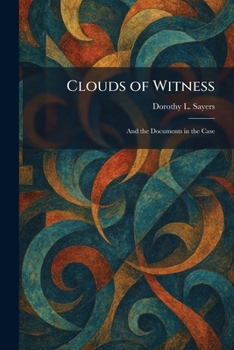
Clouds of Witness: And the Documents in the Case

Select Format
Select Condition 
Book Overview
"Clouds of Witness and the Documents in the Case" brings together two masterfully crafted mysteries from the Golden Age of Detective Fiction. In "Clouds of Witness", the aristocratic sleuth Lord Peter Wimsey faces his most personal challenge yet when his brother, the Duke of Denver, stands accused of murdering their sister's fianc . Wimsey must navigate the rigid social structures of the British peerage and race against time to uncover the truth and save his family name from a scandalous trial in the House of Lords.
"The Documents in the Case", co-written with Robert Eustace, presents a compelling psychological and scientific puzzle. Told through an innovative epistolary format-comprising letters, statements, and reports-the narrative reconstructs the events surrounding the death of a man whose passing is initially dismissed as an accidental mushroom poisoning. This work is celebrated for its early use of forensic chemistry and its sophisticated exploration of human relationships and professional jealousy.
Both stories showcase Dorothy L. Sayers's unparalleled ability to combine intricate plotting with wit and social commentary. These works remain essential examples of the classic British detective story, highlighting the evolution of the genre through meticulous deduction and character-driven drama.
This work has been selected by scholars as being culturally important, and is part of the knowledge base of civilization as we know it. This work was reproduced from the original artifact, and remains as true to the original work as possible. Therefore, you may see the original copyright references, library stamps (as most of these works have been housed in our most important libraries around the world), and other notations in the work.
This work is in the public domain in the United States of America, and possibly other nations. Within the United States, you may freely copy and distribute this work, as no entity (individual or corporate) has a copyright on the body of the work.
As a reproduction of a historical artifact, this work may contain missing or blurred pages, poor pictures, errant marks, etc. Scholars believe, and we concur, that this work is important enough to be preserved, reproduced, and made generally available to the public. We appreciate your support of the preservation process, and thank you for being an important part of keeping this knowledge alive and relevant.
Customer Reviews
ThriftBooks ® and the ThriftBooks ® logo are registered trademarks of Thrift Books Global, LLC
