


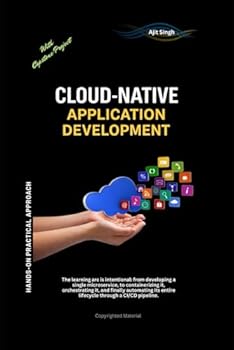
Cloud-Native Application Development
No Customer Reviews

This book is designed to be a direct and practical guide to designing, building, and deploying cloud-native applications. It bridges the critical gap between theoretical computer science concepts and the hands-on, tool-centric skills demanded by the modern technology industry. You will synthesize every skill you have acquired-from microservice design and containerization to CI/CD and observability-to execute a complete, end-to-end monolith-to-microservices transformation. You will deconstruct the limitations of monolithic design and internalize the core principles of microservices and the Twelve-Factor App methodology. This is the strategic thinking that separates an engineer from a technician. Philosophy The guiding philosophy of this book is learning by doing. I believe that true mastery of cloud-native development comes not from reading about it, but from building it. Every theoretical concept is immediately paired with practical application. I don't just explain what a Docker container is; I will guide you step-by-step through writing a Dockerfile for a real application including deployment of a multi-service application and manage its lifecycle with kubectl. The ultimate goal is to equip the reader with a robust, demonstrable skill set that is directly applicable to real-world engineering challenges. Key Features 1. Practical, Hands-On Focus: Heavy emphasis on labs, code examples, and configuration files (Dockerfiles, Kubernetes YAML, Terraform HCL) that you can run and modify. 2. Industry-Standard Tooling: Gain practical experience with the exact tools used by leading technology companies: Docker, Kubernetes, GitHub Actions, Terraform, Prometheus, Grafana, and Jaeger. 3. Step-by-Step Guidance: Complex tasks, such as building a CI/CD pipeline or configuring a Kubernetes deployment, are broken down into clear, manageable, and numbered steps suitable for learners. 4. Complete Capstone Project: A final chapter dedicated to a start-to-finish project that serves as a portfolio-worthy demonstration of your skills, including complete, explained source code. 5. Conceptual Clarity: Beyond the tools, the book ensures a deep understanding of core concepts like service decomposition, resiliency patterns, observability, and Infrastructure as Code. 6. Vendor-Agnostic Principles: While examples may use a specific cloud provider for concrete implementation, the principles and tools taught are transferable across AWS, GCP, Azure, and other cloud environments. Key Takeaways Upon completing this book, you will be able to: 1. Design and develop applications using a microservices architectural style. 2. Containerize any application using Docker and manage container images in a registry. 3. Deploy, manage, and scale complex applications on a Kubernetes cluster. 4. Automate the build, test, and deployment process using a complete CI/CD pipeline. 5. Implement the three pillars of observability (metrics, logs, traces) to monitor and debug distributed systems. 6. Apply cloud-native design patterns like Circuit Breakers and Health Checks to build resilient services. 7. Provision and manage cloud infrastructure declaratively using Terraform (Infrastructure as Code). 8. Architect a complete, end-to-end cloud-native solution from source code to a running, orchestrated, and observable system. Disclaimer: Earnest request from the Author. Kindly go through the table of contents and refer kindle edition for a glance on the related contents. Thank you for your kind consideration
Format:Paperback
Language:English
ISBN:B0GPPDZSFV
ISBN13:9798249384005
Release Date:February 2026
Publisher:Independently published
Length:309 Pages
Weight:0.92 lbs.
Dimensions:9.0" x 0.7" x 6.0"
Customer Reviews
0 rating
Copyright © 2026 Thriftbooks.com Terms of Use
| Privacy Policy | Do Not
Sell/Share My Personal Information | Cookie Policy | Cookie Preferences | Accessibility Statement
ThriftBooks® and the ThriftBooks® logo are registered trademarks of Thrift Books Global, LLC
ThriftBooks® and the ThriftBooks® logo are registered trademarks of Thrift Books Global, LLC
