


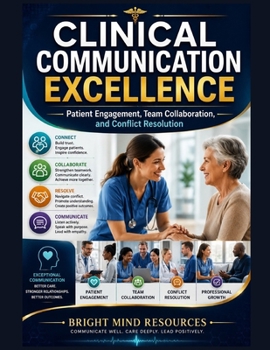
Clinical Communication Excellence: Patient Engagement, Team Collaboration, and Conflict Resolution
No Customer Reviews

Patient Engagement, Team Collaboration, and Conflict Resolution Effective healthcare depends on more than clinical knowledge. It also depends on how professionals listen, explain, collaborate, respond under pressure, manage disagreement, and build trust with patients, families, and colleagues. **Clinical Communication Excellence** provides a practical reference for developing the communication skills needed in modern healthcare environments. From patient conversations and interdisciplinary teamwork to difficult discussions, conflict management, clinical handoffs, and professional communication, this guide focuses on the situations healthcare professionals encounter every day. Whether you are a student developing foundational communication skills, a practicing professional strengthening your patient interactions, or a clinical leader working to improve team relationships, this book provides practical concepts that can be applied across healthcare settings. ### Inside this guide, readers will explore: **Patient Engagement** Learn how effective communication can support trust, understanding, participation, and shared decision-making. **Professional Listening** Develop active listening habits that help identify concerns, clarify information, and reduce misunderstandings. **Clinical Team Collaboration** Understand how clear communication supports interdisciplinary teamwork and coordinated patient care. **Difficult Conversations** Explore structured approaches for communicating when emotions are high, expectations differ, or sensitive subjects must be addressed. **Conflict Resolution** Learn practical frameworks for recognizing conflict, addressing concerns professionally, and working toward constructive outcomes. **Clinical Handoffs** Understand the importance of organized information exchange during transitions of care and changes in responsibility. **Documentation and Communication** Recognize how clear, accurate, objective documentation supports continuity, accountability, and patient safety. **Professional Boundaries** Explore respectful communication, confidentiality, empathy, cultural awareness, and appropriate professional relationships. **Leadership Communication** Develop communication habits that can support delegation, feedback, team development, problem-solving, and organizational effectiveness. **Patient-Centered Communication** Learn how communication can be adapted to individual needs, preferences, comprehension levels, and clinical circumstances. ### A practical resource for healthcare learners and professionals Strong communication is not simply about speaking clearly. It involves **listening carefully, recognizing context, asking useful questions, confirming understanding, communicating important information accurately, and responding professionally when challenges arise.** Healthcare environments can be fast-moving and complex. Misunderstandings can occur between patients and professionals, between members of an interdisciplinary team, or during transitions between departments and care settings. This guide provides a structured way to understand those communication challenges and develop more effective responses. Readers will find concepts applicable to hospitals, outpatient clinics, long-term care environments, community healthcare, rehabilitation settings, educational environments, and other professional care contexts.
Format:Paperback
Language:English
ISBN:B0HFSQLH26
ISBN13:9798193673101
Release Date:August 2026
Publisher:Independently Published
Length:274 Pages
Weight:1.41 lbs.
Dimensions:0.6" x 8.5" x 11.0"
Customer Reviews
0 rating
Copyright © 2026 Thriftbooks.com
Terms of Use | Privacy Policy | Do Not Sell/Share My Personal Information | Cookie Notice | Cookie Preferences | Accessibility Statement
ThriftBooks ® and the ThriftBooks ® logo are registered trademarks of Thrift Books Global, LLC
ThriftBooks ® and the ThriftBooks ® logo are registered trademarks of Thrift Books Global, LLC
