


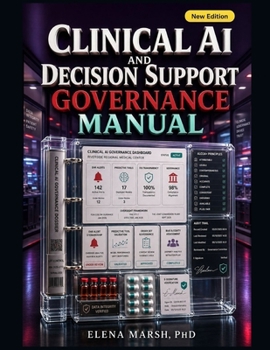
Clinical AI and Decision Support Governance Manual: EHR alerts, predictive tools, order sets, workflow review, safety controls, and executive-ready cl
No Customer Reviews

Clinical AI Governance Needs More Than Good Intentions Clinical AI governance and clinical decision support governance now sit at the center of healthcare risk, safety, and executive oversight. If your EHR alerts, predictive tools, order sets, and AI products are growing faster than your review process, you need a working governance manual, not theory. When Tools Multiply, Unowned Risk Multiplies Too Most health systems carry CDS burden. They have high-override alerts, old order sets, vendor AI claims, missing local validation files, thin bias review, and thin minutes. Doing nothing leaves the same weak spots open: unclear authority, slow alert retirement, untracked drift, scattered compliance files, and reports that do not connect tool performance to patient safety. A Desk Manual Built Around Governance Records This book gives you the operating model behind clinical AI governance and clinical decision support governance: committee authority, review gates, monitoring thresholds, incident response, regulatory mapping, and executive reporting. It is written for CMIOs, clinical informaticists, pharmacy informatics leaders, nursing informatics directors, health IT directors, quality leaders, and governance committee chairs. The method is practical: define authority, classify tools, review workflow, document the decision, monitor after launch, retire weak tools, and report risk clearly. What You Can Build From This Manual Inside, you get: - Committee charter structure, quorum rules, and voting authority
- EHR alert taxonomy, design standards, override monitoring, and retirement SOPs
- Order set review cycles, evidence checks, and sunset rules
- Predictive AI procurement review, local validation, bias assessment, and drift monitoring
- CDS incident classification, response steps, root cause review, and corrective action tracking
- CDS Hooks, FHIR, vendor review, and interoperability checkpoints
- FDA CDS Software Guidance, ONC HTI-1, and Joint Commission RUAIH alignment
- Human factors review, alert fatigue metrics, dashboards, and maturity scoring Templates You Can Adapt Without Starting Over The manual includes completed sample governance documents using one fictional health system so you can see the full record, not a blank form. You see charters, minutes, alert proposals, override memos, retirement authorizations, order set reviews, validation reports, bias assessments, incident reports, FDA classification memos, RUAIH self-assessments, dashboards, maturity scoring, and a roadmap. A decision without a record is easy to challenge. A record with clear authority, rationale, owner, date, threshold, and follow-up is far harder to ignore. Built for Leaders Who Do Not Have Extra Time This is not too technical for clinical leaders, and it is not too shallow for informatics teams. The manual explains the policy reason, then gives the governance artifact that carries the work. Use it to start a committee, fix alert fatigue, prepare for AI oversight, or turn scattered practices into a repeatable program. You do not need a perfect program before you begin. You need a defensible first review cycle, a clear authority model, and a way to prove that each clinical AI or CDS decision was examined, approved, monitored, and escalated when needed. Turn Governance From Discussion Into Evidence Use the sample pages to test fit before you buy, then bring the manual to your next governance build session. Start with the gap assessment, map your committee authority, pick one alert review problem, and produce the first record your leaders can read. Buy the manual today and give your clinical AI governance program the structure, records, and executive line it has been missing. Start now.
- EHR alert taxonomy, design standards, override monitoring, and retirement SOPs
- Order set review cycles, evidence checks, and sunset rules
- Predictive AI procurement review, local validation, bias assessment, and drift monitoring
- CDS incident classification, response steps, root cause review, and corrective action tracking
- CDS Hooks, FHIR, vendor review, and interoperability checkpoints
- FDA CDS Software Guidance, ONC HTI-1, and Joint Commission RUAIH alignment
- Human factors review, alert fatigue metrics, dashboards, and maturity scoring Templates You Can Adapt Without Starting Over The manual includes completed sample governance documents using one fictional health system so you can see the full record, not a blank form. You see charters, minutes, alert proposals, override memos, retirement authorizations, order set reviews, validation reports, bias assessments, incident reports, FDA classification memos, RUAIH self-assessments, dashboards, maturity scoring, and a roadmap. A decision without a record is easy to challenge. A record with clear authority, rationale, owner, date, threshold, and follow-up is far harder to ignore. Built for Leaders Who Do Not Have Extra Time This is not too technical for clinical leaders, and it is not too shallow for informatics teams. The manual explains the policy reason, then gives the governance artifact that carries the work. Use it to start a committee, fix alert fatigue, prepare for AI oversight, or turn scattered practices into a repeatable program. You do not need a perfect program before you begin. You need a defensible first review cycle, a clear authority model, and a way to prove that each clinical AI or CDS decision was examined, approved, monitored, and escalated when needed. Turn Governance From Discussion Into Evidence Use the sample pages to test fit before you buy, then bring the manual to your next governance build session. Start with the gap assessment, map your committee authority, pick one alert review problem, and produce the first record your leaders can read. Buy the manual today and give your clinical AI governance program the structure, records, and executive line it has been missing. Start now.
Format:Paperback
Language:English
ISBN:B0H7K1H5N8
ISBN13:9798185369258
Release Date:July 2026
Publisher:Independently Published
Length:194 Pages
Weight:1.02 lbs.
Dimensions:0.4" x 8.5" x 11.0"
Customer Reviews
0 rating
Copyright © 2026 Thriftbooks.com
Terms of Use | Privacy Policy | Do Not Sell/Share My Personal Information | Cookie Notice | Cookie Preferences | Accessibility Statement
ThriftBooks ® and the ThriftBooks ® logo are registered trademarks of Thrift Books Global, LLC
ThriftBooks ® and the ThriftBooks ® logo are registered trademarks of Thrift Books Global, LLC
