


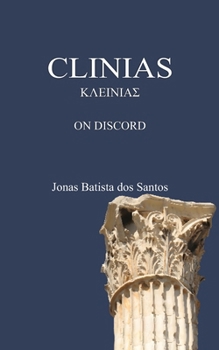
Clinias
No Customer Reviews

Athens, fifth century B.C. Thaida, a woman with spiritual aridity, seeks answers and the oracle of Delphi reveals to her a name, Clinias, Son of Axiochus, a disciple of Socrates, known for his firmness and love of truth.
Between admiration and fear, Thaida begins a dialogue that transcends. What begins as a search for guidance becomes a clash of souls: he, marked by the experience and weight of an unforgettable master; she, wounded by the illusions of the past, but willing to find out if there is still possible order in the midst of chaos. Can virtue be taught or transmitted? To what extent do the gods, or the divine, interfere with our destiny? In four acts, we follow not only the meeting between Clinias and Thaida, but also the legacy of this union: the twelve children, the philosopher Pliny who dares to question the gods, and the eternal tension between discord and order, in the human soul and on Olympus. The "dialogue" is heavily inspired by Plato, but does not follow Plato's style. The narrative unfolds in three main acts: the meeting and union of Clinias and Thaida, the philosophical debate of the son Plinius, and a mythical outcome on Olympus. The division into acts and interludes allows pauses for reflection on what was discussed. The evolution of history (meeting, debate, consequences) is logical. The passage on democracy and the quality of judgment (Act I) is a high and timeless point. The recurring idea that truth is lived, not just told, and that words may be insufficient is well explored, especially in Pl nius' suffering. Cl nias and Thaida function well as representatives of ideals (practical reason and the feminine search for fulfillment). The contrast between Clinias' experienced wisdom and Pliny's questioning youth is a good narrative resource. The Female Voice in Thaida can bother people who are slaves to ideologies, as tradition can offend postmodern ideals. The discussion about the One: The debate between Pliny and Diogo about a "single god" versus the Greek pantheon is the philosophical heart of the work is well constructed, with arguments on both sides. The work may seem to try to insert a Christian monotheistic vision within a Greek dialogue. It was a real trend of some of the period. The work does not culminate with the Christian god and has its apex in the pantheon. Insertion of Mythology: Act III and IV, with the Council of the Gods, brings an interesting turn. Humanizing the gods in their disputes (Eris vs. Athena) is a way of representing the forces at play in human existence. The image of Apollo bringing the plague as a punishment is powerful and consistent with the myth. The inspiration comes from the inhabitants of Thebes who speculated that Phebo Apollo punished them with the plague. The suffering and ultimate erasure of Plinius, under a pedantic apedeutic gaze, can be mistaken for a Christian punishment, "don't try to be like God," than a Greek one, where hybris was punished, but the pursuit of excellence, aret , was the ultimate goal. The dialogues transition to speeches. I wanted to do it that way and obviously I could have done it differently as I did in Ethereal and Theodore, where the Socratic dialogue is made up of short questions that lead the interlocutor to contradict himself. The style of this one is different and Cl nias, especially, goes ahead to deduce the interlocutor's doubt to give the impression that he knew beforehand what would be questioned of him.Format:Paperback
Language:English
ISBN:B0GD25VMSS
ISBN13:9798241788306
Release Date:December 2025
Publisher:Independently Published
Length:84 Pages
Weight:0.20 lbs.
Dimensions:0.2" x 5.0" x 8.0"
Customer Reviews
0 rating
Copyright © 2026 Thriftbooks.com
Terms of Use | Privacy Policy | Do Not Sell/Share My Personal Information | Cookie Policy | Cookie Preferences | Accessibility Statement
ThriftBooks ® and the ThriftBooks ® logo are registered trademarks of Thrift Books Global, LLC
ThriftBooks ® and the ThriftBooks ® logo are registered trademarks of Thrift Books Global, LLC
