


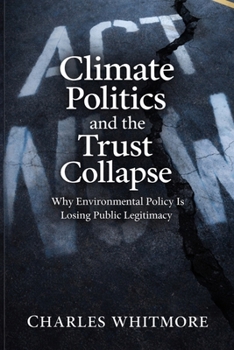
Climate Politics and the Trust Collapse: Why Environmental Policy Is Losing Public Legitimacy

Climate change is debated. Climate policy is defended. But something deeper is eroding.
Public trust.
In Climate Politics and the Trust Collapse, Charles Whitmore examines why resistance to environmental policy is rising even as awareness of climate risk remains widespread. The book does not challenge climate science. It challenges the way climate governance is designed, communicated, and enforced.
Why do policies intended to accelerate transition generate backlash? Why do rising costs translate into declining legitimacy? Why does urgency sometimes narrow public consent rather than expand it?
Whitmore argues that the conflict is not primarily about belief in climate risk. It is about confidence in institutions. When expertise appears politicized, when costs are immediate but benefits feel distant, and when moral rhetoric replaces negotiation, trust begins to weaken.
Drawing on political economy, democratic theory, and institutional analysis, this book explains how:
- Delegated authority depends on public confidence
- Crisis governance reshaped institutional credibility
- Visible household costs alter political memory
- Moral framing can shrink coalitions
- Administrative expansion fuels alienation
- Policy acceleration can outpace democratic absorption
- Climate identity hardens into partisan allegiance
This is not a manifesto. It is a structural diagnosis.
Climate Politics and the Trust Collapse offers a rigorous account of how legitimacy erodes in high cost transitions and what that erosion means for democratic governance in the decades ahead.
For readers of serious political nonfiction, policy analysis, and contemporary institutional critique, this book reframes the climate debate through the lens that matters most.
Trust.
Customer Reviews
ThriftBooks® and the ThriftBooks® logo are registered trademarks of Thrift Books Global, LLC
