


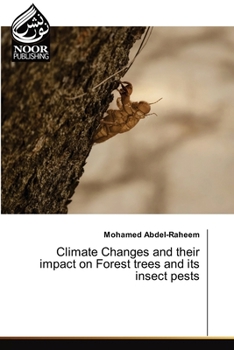
Climate Changes and their impact on Forest trees and its insect pests
No Customer Reviews

The rate and pattern of wood decay in forests changes due to influence of changing moisture and temperature regimes on decay fungi. Thus, carbon cyling rates may increase or decrease depending on the direction of future climate changes.Forest managers, whether working at the local or the landscape scale, should be aware of current and historic forest health conditions in their jurisdictions, and then integrate that knowledge with climate change projections. Monitoring, forecasting, planning and mitigation strategies are needed to prevent and to adaptively manage tree diseases at various geographic scales.Monitoring - Early detection of tree diseases can increase the potential for successful disease management. Thus, continued and improved surveillance of forests for tree health problems is required. Integrated data from state, federal (such as the USFS Forest Inventory and Analysis program and the USFS Forest Health Protection programs), and private monitoring are useful for detecting deviations from historical baseline conditions.
Format:Paperback
Language:English
ISBN:6209870031
ISBN13:9786209870033
Release Date:March 2026
Publisher:Noor Publishing
Length:180 Pages
Weight:0.55 lbs.
Dimensions:0.4" x 6.0" x 9.0"
Customer Reviews
0 rating
Copyright © 2026 Thriftbooks.com
Terms of Use | Privacy Policy | Do Not Sell/Share My Personal Information | Cookie Policy | Cookie Preferences | Accessibility Statement
ThriftBooks ® and the ThriftBooks ® logo are registered trademarks of Thrift Books Global, LLC
ThriftBooks ® and the ThriftBooks ® logo are registered trademarks of Thrift Books Global, LLC
