


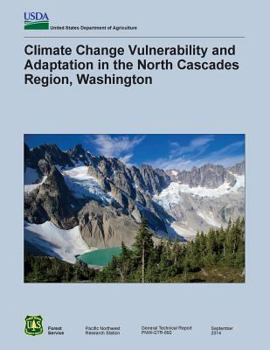
Climate Change Vulnerability and Adaptation in the North Cascades Region, Washington
No Customer Reviews

The North Cascadia Adaptation Partnership (NCAP) is a science-managementpartnership consisting of the U.S. Department of Agriculture Forest Service MountBaker-Snoqualmie and Okanogan-Wenatchee National Forests and Pacific NorthwestResearch Station; North Cascades National Park Complex; Mount RainierNational Park; and University of Washington Climate Impacts Group. Theseorganizations worked with numerous stakeholders over 2 years to identify climatechange issues relevant to resource management in the North Cascades and to findsolutions that will facilitate the transition of the diverse ecosystems of this regioninto a warmer climate. The NCAP provided education, conducted a climate changevulnerability assessment, and developed adaptation options for federal agencies thatmanage 2.4 million hectares in north-central Washington.In the Pacific Northwest, the current warming trend is expected to continue, with average warming of 2.1 C by the 2040s and 3.8 C by the 2080s; precipitationmay vary slightly, but the magnitude and direction are uncertain. This warmingwill have far-reaching effects on aquatic and terrestrial ecosystems. Hydrologic systemswill be especially vulnerable as North Cascades watersheds become increasinglyrain dominated, rather than snow dominated, resulting in more autumn/winterflooding, higher peak flows, and lower summer flows. This will greatly affect theextensive road network in the North Cascades (longer than 16 000 km), making itdifficult to maintain access for recreational users and resource managers. It willalso greatly reduce suitable fish habitat, especially as stream temperatures increaseabove critical thresholds. In forest ecosystems, higher temperatures will increasestress and lower the growth and productivity of lower elevation tree species onboth the western and eastern sides of the Cascade crest, although growth of highelevationtree species is expected to increase. Distribution and abundance of plantspecies may change over the long term, and increased disturbance (wildfire, insects, and invasive species) will cause rapid changes in ecosystem structure and functionacross broad landscapes, especially on the east side. This in turn will alter habitatfor a wide range of animal species by potentially reducing connectivity and latesuccessionalforest structure.Coping with and adapting to the effects of an altered climate will becomeincreasingly difficult after the mid-21st century, although adaptation strategies and tactics are available to ease the transition to a warmer climate. For roads andinfrastructure, tactics for increasing resistance and resilience to higher peak flowsinclude installing hardened stream crossings, stabilizing streambanks, designingculverts for projected peak flows, and upgrading bridges and increasing theirheight. For fisheries, tactics for increasing resilience of salmon to altered hydrologyand higher stream temperature include restoring stream and floodplain complexity, reducing road density near streams, increasing forest cover to retain snowand decrease snow melt, and identifying and protecting cold-water refugia. Forvegetation, tactics for increasing resilience to higher temperature and increaseddisturbance include accelerating development of late-successional forest conditionsby reducing density and diversifying forest structure, managing for future range ofvariability in structure and species, including invasive species prevention strategiesin all projects, and monitoring changes in tree distribution and establishment at treeline. For wildlife, tactics for increasing resilience to altered habitat include increasingdiversity of age classes and restoring a patch mosaic, increasing fuel reductiontreatments in dry forests, using conservation easements to maintain habitat connectivity, and removing exotic fish species to protect amphibian populations.
Format:Paperback
Language:English
ISBN:197439879X
ISBN13:9781974398799
Release Date:January 1
Publisher:Createspace Independent Publishing Platform
Length:292 Pages
Weight:1.50 lbs.
Dimensions:0.6" x 8.5" x 11.0"
Customer Reviews
0 rating
Copyright © 2026 Thriftbooks.com Terms of Use
| Privacy Policy | Do Not
Sell/Share My Personal Information | Cookie Policy | Cookie Preferences | Accessibility Statement
ThriftBooks® and the ThriftBooks® logo are registered trademarks of Thrift Books Global, LLC
ThriftBooks® and the ThriftBooks® logo are registered trademarks of Thrift Books Global, LLC
