


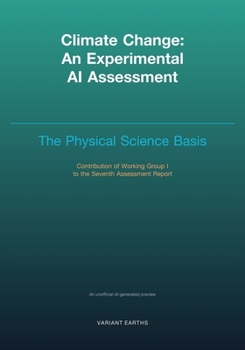
Climate Change - An Experimental AI Assessment: Volume I: The Physical Science Basis

What will the IPCC's Seventh Assessment Report say about the physical science of climate change? This volume is an experiment in answering that question before the report exists. Using Anthropic's Claude and a source-first methodology, we generated a complete Working Group I assessment-10 chapters plus a Summary for Policymakers and Technical Summary-structured to match the official AR7 outlines adopted at the IPCC's 62nd Plenary Session in Hangzhou, February 2025.
The result is 341 pages covering the full scope of WGI: large-scale changes in the climate system and their causes, including the acceleration of global mean surface temperature to 1.60 C above the 1850-1900 baseline in 2024; regional climate change and extremes across all inhabited regions; advances in process understanding of biogeochemical cycles, short-lived climate forcers, the energy budget, water cycle, cryosphere, and ocean dynamics; scenarios and projected future temperatures under the full range of Shared Socioeconomic Pathways; global and regional projections of Earth system responses across timescales from near-term to multi-century; abrupt changes, low-likelihood high-impact events, and critical thresholds including tipping points in the Earth system; pathways toward temperature stabilization including overshoot scenarios and carbon dioxide removal; and the rapidly evolving field of climate information and services. Every chapter includes an Executive Summary with calibrated IPCC uncertainty language, IPCC-style figures, frequently asked questions, and a full reference list.
The key methodological innovation is source-first citation verification. Rather than generating text and hoping the citations are real, we reversed the pipeline: citations were discovered via scholarly search, verified against the OpenAlex database using author name, publication year, and a climate science concept filter (C132651083), and only then used to support claims. Of 513 unique citations across all three volumes, 449 (87.5%) were matched to real publications with DOI confirmation. The unverified 12.5% are flagged transparently in the bibliography. Three rounds of adversarial quality assurance targeted factual errors, placeholder text, encoding corruption, structural inconsistencies, and non-compliant IPCC uncertainty pairings.
This work is not endorsed by the Intergovernmental Panel on Climate Change, the United Nations, or any national government. It cannot replace the expert judgment of hundreds of domain specialists, the assessment of grey literature and government reports, or the deliberative process that makes IPCC reports authoritative. The figures are illustrative, not derived from climate model output. The confidence calibrations are algorithmically derived, not validated through formal expert elicitation. What this volume can do is test a question that matters to anyone thinking about the future of scientific assessment: how close can a frontier AI model, constrained by real literature and structured methodology, come to producing a credible synthesis of published climate science?
We invite climate scientists, IPCC authors, and climate communicators to read it and tell us what we got right, what we got wrong, and what this experiment means. Feedback can be submitted as GitHub issues or by email. Critical feedback is the most useful kind.
Part of the three-volume Climate Change: An Experimental AI Assessment series (ISBN 978-1-60888-790-3, 978-1-60888-791-0, 978-1-60888-792-7). Complete methodology, all prompts, verification scripts, and citation verification data published openly at github.com/fredzannarbor/ar7-ai-assessment.
Customer Reviews
ThriftBooks ® and the ThriftBooks ® logo are registered trademarks of Thrift Books Global, LLC
