


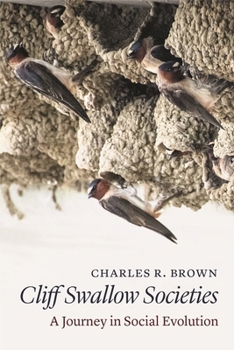
Cliff Swallow Societies: A Journey in Social Evolution

The cliff swallow is one of the most social birds in the world, stacking its mud nests underneath overhanging ledges of cliffs and on the sides of bridges and buildings. Charles R. Brown began studying the evolution of group-living in cliff swallows more than forty-five years ago, conducting one of the longest-running field studies of birds in North America. Cliff Swallow Societies tells the story of this remarkable research by tracing its origins to the author's boyhood experiences and how his lifelong obsession with cliff swallows motivated him to persist with his observations.
In Cliff Swallow Societies the reader watches Brown make professional choices at different crossroads, secure funds for the work, overcome scientific obstacles, and recruit people to assist him. He brings the reader along on his scientific odyssey, with its challenges and rewards. On his journey Brown finds that natural selection can be witnessed in real time and that cliff swallow biology varies in response to a changing environment. Brown's long-term synthesis will appeal to anyone interested in birds, evolution, group-living, and how science is done.
Customer Reviews
ThriftBooks ® and the ThriftBooks ® logo are registered trademarks of Thrift Books Global, LLC
