


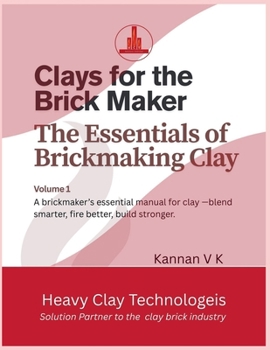
Clays for the Brick Maker
No Customer Reviews

The manufacturing of high-quality clay bricks begins with a thorough
understanding of the raw materials involved-particularly the
characteristics and composition of the soil. Among the many variables
that influence brick performance, the type of soil and its particle size
distribution play a critical role in shaping the physical, thermal, and
mechanical behavior of the final product.
This book presents a structured overview of the types of soils used in
the brick industry, guided by the classification framework provided by
the Winkler diagram. The document further explores the significance of
clay mineralogy, the role of particle size distribution (PSD) testing, and
their implications for raw material selection, process control, and
product quality.
Format:Paperback
Language:English
ISBN:B0FP9X7V5W
ISBN13:9798231596249
Release Date:August 2025
Publisher:Kannan V K
Length:54 Pages
Weight:0.33 lbs.
Dimensions:0.1" x 8.5" x 11.0"
Customer Reviews
0 rating
Copyright © 2026 Thriftbooks.com
Terms of Use | Privacy Policy | Do Not Sell/Share My Personal Information | Cookie Notice | Cookie Preferences | Accessibility Statement
ThriftBooks ® and the ThriftBooks ® logo are registered trademarks of Thrift Books Global, LLC
ThriftBooks ® and the ThriftBooks ® logo are registered trademarks of Thrift Books Global, LLC
