


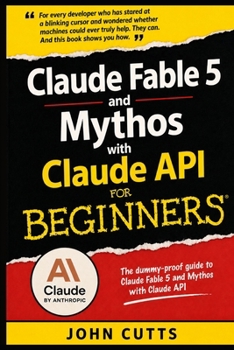
Claude Fable 5 and Mythos with Claude API For Beginners: No Prior Knowledge Needed, Even If You're a Total Beginner

Written by John Cutts-a principal software engineer with over fifteen years of experience building distributed systems and teaching applied machine learning-Claude Fable 5 and Mythos is a comprehensive, zero-to-hero roadmap designed to take you from a complete beginner to a confident builder of autonomous AI systems. Whether you are a working developer looking to expand your toolkit or a curious tech enthusiast with absolutely no prior AI experience, this book breaks down complex concepts into practical, step-by-step coding exercises.
Why This Book Is DifferentMany books on artificial intelligence require an advanced degree or a heavy background in mathematics. This guide turns that paradigm on its head. You do not need a PhD in machine learning, and you do not need to have worked with AI before. Armed with just curiosity, a basic willingness to write code, and API access, you will build production-grade architectures alongside an industry veteran.
A Complete, Practical CurriculumThis book deliberately structures your learning path so that each chapter cleanly scales your capabilities:
Meet the Core Models: Discover how to navigate Anthropic's model families, distinguishing between the high-speed Haiku, the balanced and pragmatic Sonnet, the deeply intelligent Opus, the production-ready Fable 5, and the frontier-level preview capabilities of Mythos.
Understand Claude's Mind: Take a look behind the curtain at the mechanics of tokenization, embeddings, contextualization, and generation to write highly predictable software integrations.
Manage Conversational Context: Master multi-turn message histories, utilize system prompts to assign specialized expert roles, and control output creativity using temperature dials.
Optimize the User Experience: Implement streaming text responses that mimic real-time typing, and combine assistant message prefilling with stop sequences to extract clean, structured formats like raw JSON without unnecessary commentary.
Advanced Prompt Engineering: Learn empirical techniques like role assignment, few-shot prompting, XML structural tagging, and chain-of-thought reasoning pipelines to build reliable automated grading scorers.
Give Claude Hands and Eyes: Implement the tool use loop (function calling) to let Claude interact with external systems, use multimodal vision capabilities to analyze charts and images, and configure document analysis featuring exact passage citations.
Prompt Caching & The Files API: Save massive amounts of latency and operational costs by caching long system prompts, large tool arrays, or extensive reference files.
The Model Context Protocol (MCP): Connect Claude to external environments using the standardized MCP architecture, and build a customized document management MCP server from scratch in Python.
Claude Code Pair Programming: Unlock a terminal-based AI pair programmer, leveraging the CLAUDE.md workspace initialization framework to smoothly delegate test-driven development and implementation planning.
Production Workflows vs. Autonomous Agents: Design predictable workflow patterns-including chaining, parallelization, routing, and evaluator-optimizer loops-and learn when to safely deploy flexible, autonomous agents governed by bounded autonomy and environment inspection.
Retrieval-Augmented Generation (RAG): Overcome context limits by building a searchable external knowledge store with vector databases, leading up to the next evolution: Agentic RAG.
Customer Reviews
ThriftBooks ® and the ThriftBooks ® logo are registered trademarks of Thrift Books Global, LLC
