


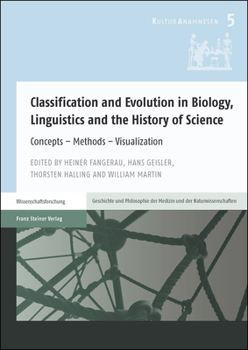
Classification and Evolution in Biology, Linguistics and the History of Science: Concepts - Methods - Visualization
No Customer Reviews

While Darwin's grand view of evolution has undergone many changes and shown up in many facets, there remains one outstanding common feature in its 150-year history: since the very beginning, branching trees have been the dominant scheme for representing evolutionary processes. Only recently, network models have gained ground reflecting contact-induced mixing or hybridization in evolutionary scenarios. In biology, research on prokaryote evolution indicates that lateral gene transfer is a major feature in the evolution of bacteria. In the field of linguistics, the mutual lexical and morphosyntactic borrowing between languages seems to be much more central for language evolution than the family tree model is likely to concede. In the humanities, networks are employed as an alternative to established phylogenetic models, to express the hybridization of cultural phenomena, concepts or the social structure of science. However, an interdisciplinary display of network analyses for evolutionary processes remains lacking. Therefore, this volume includes approaches studying the evolutionary dynamics of science, languages and genomes, all of which were based on methods incorporating network approaches.
Format:Paperback
Language:English
ISBN:3515104607
ISBN13:9783515104609
Release Date:November 2013
Publisher:Franz Steiner Verlag Wiesbaden GmbH
Length:198 Pages
Customer Reviews
0 rating
Copyright © 2026 Thriftbooks.com Terms of Use
| Privacy Policy | Do Not
Sell/Share My Personal Information | Cookie Policy | Cookie Preferences | Accessibility Statement
ThriftBooks® and the ThriftBooks® logo are registered trademarks of Thrift Books Global, LLC
ThriftBooks® and the ThriftBooks® logo are registered trademarks of Thrift Books Global, LLC
