


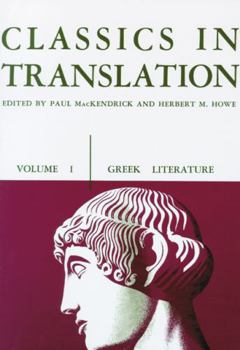
Classics in Translation, Volume I: Greek Literature


Select Format
Select Condition 
Book Overview
Diplomat DeWitt Clinton Poole arrived for a new job at the United States consulate office in Moscow in September 1917, just two months before the Bolshevik Revolution. In the final year of World War I, as Russians were withdrawing and Americans were joining the war, Poole found himself in the midst of political turmoil in Russia. U.S. relations with the newly declared Soviet Union rapidly deteriorated as civil war erupted and as Allied forces intervened in northern Russia and Siberia. Thirty-five years later, in the climate of the Cold War, Poole recounted his experiences as a witness to that era in a series of interviews.
Historians Lorraine M. Lees and William S. Rodner introduce and annotate Poole's recollections, which give a fresh, firsthand perspective on monumental events in world history and reveal the important impact DeWitt Clinton Poole (18851952) had on U.S.Soviet relations. He was active in implementing U.S. policy, negotiating with the Bolshevik authorities, and supervising American intelligence operations that gathered information about conditions throughout Russia, especially monitoring anti-Bolshevik elements and areas of German influence. Departing Moscow in late 1918 via Petrograd, he was assigned to the port of Archangel, then occupied by Allied and American forces, and left Russia in June 1919.
"
Historians Lorraine M. Lees and William S. Rodner introduce and annotate Poole's recollections, which give a fresh, firsthand perspective on monumental events in world history and reveal the important impact DeWitt Clinton Poole (18851952) had on U.S.Soviet relations. He was active in implementing U.S. policy, negotiating with the Bolshevik authorities, and supervising American intelligence operations that gathered information about conditions throughout Russia, especially monitoring anti-Bolshevik elements and areas of German influence. Departing Moscow in late 1918 via Petrograd, he was assigned to the port of Archangel, then occupied by Allied and American forces, and left Russia in June 1919.
"
Format:Paperback
Language:English
ISBN:0299808955
ISBN13:9780299808952
Release Date:July 1959
Publisher:University of Wisconsin Press
Length:446 Pages
Weight:1.22 lbs.
Dimensions:1.0" x 6.0" x 8.5"
Customer Reviews
3 ratings
Want the real skinny on Greek and Roman literature?
Published by bernie4444 , 10 months ago
This book was written for the Liberal Studies program of the University of Wisconsin.
In 1599, in Shakespeare's play Julius Caesar, Casca states, "... for mine own part, it was Greek to me." That is how a lot of people see classics like "The Iliad of Homer."
Even the translations leave something to be desired for a person who does not have the context and prefers modern idioms. This way, one does not miss out on the rich classical world (the painless way).
I bought this book for a different view of Homer. Then I found this a good companion to many other books in my library. If you do not buy the originals, this is a good overview.
Table of contents and comments
Published by Thriftbooks.com User , 17 years ago
Since this venerable book (originally published 1952) remains a good compendium of Latin literature including both prose and poetry, and since one cannot view the table of contents on line, I have reproduced the TOC taking some liberties with the titles to put them in a form classicists would recognize. I've included the (translators) of each section. The compendium is notable for its lack of material from Caesar and Martial and any of Ovid's love poetry. Moreover, in keeping with its times, the poetry of Catullus and Juvenal is bowdlerized. I recommend a review by Edward J. Bassett, CP 48 (1953) 109-112, http://www.jstor.org/stable/265407. It lists the many misprints in the book in footnote 1. I remain dissatisfied with the other possibilities for a text for a course on Latin literature in translation. Atchity is too thin on material, Russell has only prose. I do find Lombardo's Essential Aeneid very useful. TOC Roman Culture: An Essay (MacKendrick) p.3 Mostellaria of Plautus (Harry J. Leon) p.13 Andria of Terence (R. I. Wilfred Westage & Rogers V. Scudder) p.38 De Rerum Natura of Lucretius (Alban D. Winspear) p.60 -Invocation to Venus -Lucretius gives reasons for opposition to Roman institutional religion -The creed of religion vs. the creed of science -The poet's theme -The tranquil life -The movement of the atoms -Atoms vary in shape -In praise of his teacher Epicurus: The moral value of his philosophy -Lucretius with his arguments tries to banish the rear of death -The argument against the fear of death, continued -Lucretius discourses on sex and love -In praise of Epicurus and his achievements in moral enlightenment -The argument of the fifth book -The world is not eternal or divine -The life of primitive man -The evolution of man and human institutions -Origin of belief in the gods -The evolution of human institutions, continued -The great plague at Athens Selections from Sallust (MacKendrick) p.85 -The Jugurthine War p.86 -The Conspiracy of Catiline p.92 -To Caesar on the Republic, II p.99 Selections from the speeches of Cicero (Norman J. DeWitt) p.100 -Against Rullus (De lege agraria II contra Rullum ) p.102 -Pro Cluentio p.106 -Pro Sestio p.112 -Pro Murena p.115 -Pro Caelio p.120 -Pro Milone p.126 -Philippic II p.134 -Philippic IX p.140 Selections from philosophical works (MacKendrick) p.146 -Scipio's Dream from De Republica p.147 -De legibus p.153 -De finibus bonorum et malorum p.162 -Tusculan disputations p.171 -De natura deorum p.176 -On divination p.185 -On old age p.187 -On friendship p.190 -On duty p. 193 Selections from the poems of Catullus (Eric A. Havelock) p.204 -1 p.205 -27, 31, 41, 5 p.206 -7, 2, 3 p.207 -43, 86, 87, 92, 107, 101 p.208 -96, 68b p.209 -70, 8 p.210 -75,72, 85, 76 p.211 -58, 11, 38 p.212 Selections from the Georgics of Vergil (Robert Fitzgerald & Smith Palmer Bovie) p.213 -From the first Georgic p.213 -From the second Georgic p.217 Selections from the Aene
Excellent anthology of Latin literature
Published by Thriftbooks.com User , 26 years ago
MacKendrick and Howe have taken passages from some of the most famous, the most enticing, and the most influential authors and works and compiled them in this wonderful book. This is a must have volume for anyone interested in classics, in history, or in literature. The selections are well edited and well chosen for their significance to both the ancient and modern worlds. Highly recommended to any student or teacher who wishes to broaden their knowledge and understanding.
Copyright © 2026 Thriftbooks.com
Terms of Use | Privacy Policy | Do Not Sell/Share My Personal Information | Cookie Policy | Cookie Preferences | Accessibility Statement
ThriftBooks ® and the ThriftBooks ® logo are registered trademarks of Thrift Books Global, LLC
ThriftBooks ® and the ThriftBooks ® logo are registered trademarks of Thrift Books Global, LLC
