


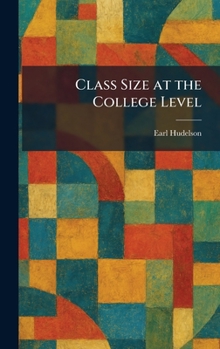
Class Size at the College Level

"Class Size at the College Level" presents a foundational study on one of the most persistent debates in higher education: the impact of class size on student achievement and instructional effectiveness. This work provides a detailed empirical analysis of experimental data gathered at the university level to determine whether smaller class settings inherently provide a superior learning environment compared to larger lecture formats.
Author Earl Hudelson meticulously examines various factors, including student grades, faculty workload, and the psychological effects of different classroom environments. By utilizing rigorous statistical methods of the era, the book challenges common assumptions about the necessity of small classes, offering surprising insights into how instructional quality and student performance interact with enrollment numbers.
This volume remains a significant historical reference for educators, administrators, and researchers interested in the evolution of pedagogical theory and the logistical challenges of university instruction. It offers a unique look at early 20th-century educational psychology and the data-driven efforts to optimize the college experience for both students and instructors.
This work has been selected by scholars as being culturally important, and is part of the knowledge base of civilization as we know it. This work was reproduced from the original artifact, and remains as true to the original work as possible. Therefore, you may see the original copyright references, library stamps (as most of these works have been housed in our most important libraries around the world), and other notations in the work.
This work is in the public domain in the United States of America, and possibly other nations. Within the United States, you may freely copy and distribute this work, as no entity (individual or corporate) has a copyright on the body of the work.
As a reproduction of a historical artifact, this work may contain missing or blurred pages, poor pictures, errant marks, etc. Scholars believe, and we concur, that this work is important enough to be preserved, reproduced, and made generally available to the public. We appreciate your support of the preservation process, and thank you for being an important part of keeping this knowledge alive and relevant.
Customer Reviews
ThriftBooks ® and the ThriftBooks ® logo are registered trademarks of Thrift Books Global, LLC
