


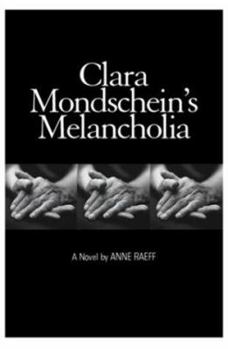
Clara Mondschein's Melancholia

From the text: "When I was younger, I wished I had been born in a concentration camp like my mother instead of in boring Englewood Hospital. I used to imagine all the prisoners crying mutely with joy... This description may be from another edition of this product.
Format:Hardcover
Language:English
ISBN:1931561168
ISBN13:9781931561167
Release Date:September 2002
Publisher:Macadam Cage Pub
Length:258 Pages
Weight:1.25 lbs.
Dimensions:9.3" x 1.0" x 6.3"
Customer Reviews
5 ratings
Powerful and Heartbreaking
Published by Thriftbooks.com User , 16 years ago
Mailer once said the novel provides the highest moral judgment. Clara Mondchein's Melancholia is a small novel dealing with big themes and a somber history, and its morality derives partially from its powerful descriptions of a horrible past that only the harebrained dare to deny. For example, the description of the fictitious Pribor camp on page 110 is heartbreaking; the image stayed in my mind for days of how the prisoners wouldn't speak to each other. The author, Anne Raeff, is subtle in her description of mood and a minimalist in depiction of physical surroundings, qualities that somehow breathe soul into this tale of loyalty, survival, and the hideous nature of depression. When a writer, especially a first time novelist, attempts a story of such historical weight and emotional charge, it is difficult to resist threading into waters that in hindsight is nothing but schmaltz. But Raeff does not take confidence so far as to get preachy or patronizing. The main character is Clara Mondschein of the title, who suffers from depression and lives indoors for greater swaths of the novel. But she's not telling her story, thank God for that, because given her illness it would've made for an uninteresting read. Luckily, the task befalls on the two closest people to her, or two people whom, by convention or upbringing, we expect to be her closest relations. Her mother, Ruth, and daughter, Deborah. Ruth mainly narrates the background story of the family to Tommy, who's dying of AIDS, and who is authentically and believably portrayed in a side story where he has shunned his ordinary parents for their lack of sympathy. Deborah narrates the more recent events, in particular the family's life in New York and suburban New Jersey, and their visit to Madrid one recent summer, where she befriends an Irish alcoholic, a poet three times her senior, with whom she spends quite a bit of time. These two narratives, in alternating chapters, make up the structure of the novel. The point about structure that is of importance here is that Deborah's narrative, and what she has to say about her mother, is the main story, and Ruth's recollection of the past and her spending time at the bedside of a dying man is the B story. If Raeff were to tell the story in a linear way, as is recommended to the first time novelist, she should not have started the B story until after the opening and maybe about a quarter into the book. But in an overt rearrangement of the structure, the novel begins with the B story, where Ruth meets Tommy and at his behest starts telling him about her youthful love and aborted pregnancy, and her subsequent introduction to her future husband, Karl, who turned out to be gay. There are other structural shifts in this novel, a reassuring sign that the initial supplanting of story A with story B is the result of patient deliberation, and that the author has used quite adeptly her innate knowledge of form to mold her story. This with her sporadic notes on mu
A great modern voice in fiction
Published by Thriftbooks.com User , 23 years ago
Great at evoking a sense of place and mood. I really felt the difference between the chapters as "Deborah" and the chapters as "Ruth." Laugh-outloud funny at times and sad the next. Raeff has clearly lived with people suffering from depression; she understands their rituals and need to inflict suffering and control others. A real find.
A great new book
Published by Thriftbooks.com User , 23 years ago
Clara Mondschein's Melancholia is one of those books that you wish would never end! What a great new addition to the contemporary literary scene!The book alternates between the voices of Mrs. Mondschein, a holocaust survivor from a modest Jewish family in Vienna, now living on Manhattan's west side, and her granddaughter, Deborah, an adolescent growing up in Tenafly, NJ, a New York City suburb. I could go on indefinitely listening to the 85-year-old Mrs. Mondschein telling her life story to Tommy as he lies dying of AIDS, and I could imagine forging ahead with Deborah as she charts her own future life course. As grandmother and granddaughter narrate, they thoughtfully weave together not only the compelling dramas of their own lives, but numerous issues that have pervaded the human condition probably since human life began. In her writing, Ms. Raeff is particularly adept at creating vivid moods, and describing the subtleties of contextual ambience, enabling the reader to really feel almost physically present in the book's varied settings -- from a dingy apartment in 1930's Vienna, to a lively neighborhood bar in 1990's Madrid, to a subway station in New York City (to name just a few settings). With Mrs. Mondschein, we ponder the horrors of the holocaust from the distance of 50 years of subsequent living to see how some of its victims and survivors suffered, but also emerged with new strength and hope for a better world. Ms. Raeff's presentation of Mrs. Mondschein's time in a concentration camp creatively departs from the usual descriptions, as Mrs. Mondschein enters into an enigmatic relationship with the camp's commandant. Mrs. Mondschein's story also leads the reader to reflect upon the nature of love, intimacy, and companionship as she spends most of her adult life happily married to a gay man. Deborah's story will probably remind many adult readers of their own adolescent angst, or perhaps of their own, seemingly all-knowing, sarcastic adolescent children. But Deborah's tough talk masks her insecurities as an adolescent dealing with forming her own identity, separate from her parents, whose influences she cannot, and ultimately does not want to fully deny. Deborah, an accomplished cellist, sensitively, and with humor, describes how she is caught between two worlds. On the one hand she goes through the motions of adolescent life in an affluent American suburb at the end of the 20th century, but on the other hand she must deal with the world of her intellectual parents who are rather removed from the realities of late 20th century life. A major portion of Deborah's narrative revolves around the summer she and her family spent in Spain, where she befriends a middle-aged Irish alcoholic, and where she also begins to come to terms with her lesbian sexual identity. And so, what of Clara Mondschein, the title character? Clara is Mrs. Mondschein's daughter, and Deborah's mother, and their attempts to deal with Clara's debilitating depressi
A novel for a diverse audience
Published by Thriftbooks.com User , 23 years ago
Clara Mondschein's Melancholia brings together an array of intelligent characters, as diverse as the historical and cultural conditions in which they live. Differences of gender, age, and sexual orientation--all are blended in a memorable tapestry of stories that become one story through the voices of the two narrators--the grandmother, a Holocaust survivor from Vienna, and her granddaughter, a teenage girl with musical talent and lesbian inclinations. Tying the two narrative threads together is the struggle of the grandmother and granddaughter to understand Clara, the daughter/mother who suffers from debilitating bouts of depression.Anne Raeff's prose brings a smile to the lips, tears to the eyes, and enlightenment to the mind. No character or event is wasted. Even the most minor characters are well drawn, and the voices of the two narrators are particularly strong, honest, and insightful. The book was a pleasure to read, despite the need to treat harrowing events of twentieth-century European history. I was sorry it had to end.
In the shadow of the Holocaust
Published by Thriftbooks.com User , 24 years ago
I found this book a very insightful and gripping account of ways in which the Holocaust affected three generations of women. I highly recommend it not only to readers who are interested in the Holocaust and its survivors, but also to those who are interested in women's lives and relationships. The book thoughtfully examines ways in which people respond to horrific tragedy and goes on to discern shadows cast by these experiences on later generations. It is composed of two narratives, one of Ruth, the resilient Holocaust survivor, who tells her story to a dying AIDS patient, and that of Deborah, Ruth's searching teenage granddaughter. Both women tell their own stories, and separately paint a haunting portrait of Clara, Ruth's sensitive and suffering daughter, and Deborah's mother. I think that Ms. Raeff is especially successful with Ruth's story, which really drives the book. When Ruth spoke, I just couldn't put the book down! Ruth grows up in Vienna in a family riven by tragedy; her mother runs away and her father, under the stress of growing anti-Semitism, becomes depressed and eventually dies of "melancholia". Following a failed love affair, Ruth marries her father's doctor, who it turns out, is gay. They find a hiding place during the war in the Austrian Alps, are eventually found out, and spend the remainder of the war in Pribor, a fictional concentration camp. Under the favor of the camp commander and the protection of other prisoners, Ruth is somehow able to survive, give birth to a daughter, Clara, and make her way to a refugee camp in Germany and later New York. These vivid historical details, the incredible drama of the tale, and Ruth's emotional honesty really brought me into her world, and gave me a better understanding of how some people were able to cope, and others less so, when swept into the tempest of the Holocaust. Ruth is able to step outside the fray emotionally and deflect horror or absurdity by maintaining a cool, critical distance. Deborah's tale, not driven as is Ruth's by historical flow, meanders through her home in suburban New Jersey to Madrid, and a series of relationships with a variety of somewhat quirky characters. Deborah's failed attempts to alleviate her mother's suffering seem to have taught her to distance herself from other people; in this outsider status I found parallels with Ruth. Ms. Raeff's rendering of Deborah's inner life, a mixture of adolescent edginess, critical insight, and naivite, seemed to me especially true and powerful. Born in the concentration camp and subjected to Ruth's accounts of these horrors, Clara lives with demons. Both Ruth and Deborah try to make sense of her regular, and increasing depressions which literally paralyze her for long periods and the harrowing rituals she uses to connect her with her past. This portrait is the most extreme and mysterious aspect of Raeff's novel; the task of making sense of Clara's "melancholia" also falls to the r
Copyright © 2026 Thriftbooks.com
Terms of Use | Privacy Policy | Do Not Sell/Share My Personal Information | Cookie Policy | Cookie Preferences | Accessibility Statement
ThriftBooks ® and the ThriftBooks ® logo are registered trademarks of Thrift Books Global, LLC
ThriftBooks ® and the ThriftBooks ® logo are registered trademarks of Thrift Books Global, LLC
