


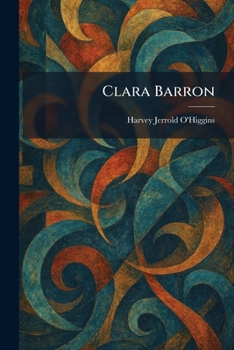
Clara Barron

"Clara Barron" is a compelling psychological novel that explores the complexities of identity, independence, and the societal pressures facing women in the early twentieth century. The narrative follows Mary Elizabeth, a young woman who, after a family crisis in her native Canada, renames herself Clara Barron and relocates to New York City to forge a new path for herself.
As Clara navigates the bustling landscape of Manhattan, she becomes a dedicated social reformer, driven by a rigid moral code and a desire to distance herself from her past. The novel delves deeply into her inner world, utilizing themes of psychoanalysis to examine the subconscious motivations and childhood experiences that shape her adult life. Through her relationships and her work in the burgeoning social justice movements of the era, Clara's journey becomes a poignant study of the struggle between personal desire and the drive for self-reliance.
Harvey Jerrold O'Higgins presents a sophisticated character study that highlights the shift in gender roles and the pursuit of individual agency during a period of significant social change. "Clara Barron" remains a significant work of early American psychological fiction, offering readers a window into the evolution of the modern woman and the psychological depth of the human condition.
This work has been selected by scholars as being culturally important, and is part of the knowledge base of civilization as we know it. This work was reproduced from the original artifact, and remains as true to the original work as possible. Therefore, you may see the original copyright references, library stamps (as most of these works have been housed in our most important libraries around the world), and other notations in the work.
This work is in the public domain in the United States of America, and possibly other nations. Within the United States, you may freely copy and distribute this work, as no entity (individual or corporate) has a copyright on the body of the work.
As a reproduction of a historical artifact, this work may contain missing or blurred pages, poor pictures, errant marks, etc. Scholars believe, and we concur, that this work is important enough to be preserved, reproduced, and made generally available to the public. We appreciate your support of the preservation process, and thank you for being an important part of keeping this knowledge alive and relevant.
Customer Reviews
ThriftBooks ® and the ThriftBooks ® logo are registered trademarks of Thrift Books Global, LLC
