


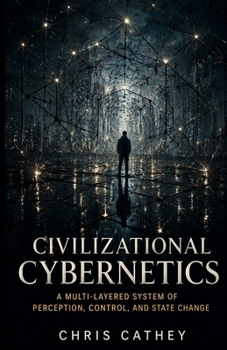
Civilizational Cybernetics: A Multi-Layered System of Perception, Control, and State Change

Civilizational Cybernetics presents a unified model of perception, cognition, and social systems as interconnected feedback-driven processes.
Most people assume they experience reality directly. They do not. What they experience is a constructed model, shaped by prediction, attention, and constraint.
This book examines how those models are formed, stabilized, and changed.
Drawing from cybernetics, cognitive science, and systems theory, it shows:
How perception is constructed rather than receivedHow feedback loops shape behavior and beliefHow identity functions as a constraint systemHow narratives coordinate large-scale social systemsHow AI extends cognition beyond the individualHow accelerating feedback loops increase instabilityWhy control is limited and influence is constrainedAt the center of the analysis is a core principle:
Complex systems can be influenced-but not fully controlled-without consequence.
From individual perception to civilization-scale dynamics, this book maps the structure of systems that generate reality, meaning, and behavior.
It does not offer simplistic solutions.
It provides a framework for understanding the system you are already inside-and the limits that govern how it can be shaped.
Customer Reviews
ThriftBooks ® and the ThriftBooks ® logo are registered trademarks of Thrift Books Global, LLC
