


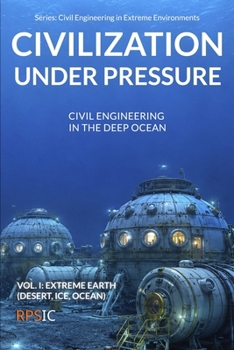
Civilization Under Pressure: Civil Engineering in the Deep Ocean (Civil Engineering in Extreme Environments)

Civilization Under Pressure explores how civil engineering makes it possible to design, build, and maintain infrastructure in one of the most demanding environments on Earth: the deep ocean.
Beneath the sea, every engineering decision changes. Pressure increases relentlessly with depth. Structures must resist crushing forces while also being anchored against buoyancy. The seabed may be soft, unstable, and difficult to investigate. Salt water attacks materials, communication becomes difficult, maintenance requires robots and specialized vessels, and every intervention is constrained by darkness, isolation, and logistics.
Through real-world cases, technical diagrams, tables, and engineering decisions, this book examines:
Hydrostatic pressure and pressure-resistant structuresSeabed geotechnics, foundations, piles, and suction caissonsSubsea tunnels, pipelines, and communication cablesCorrosion, fatigue, biofouling, and durabilityLife support, energy, water, and underwater habitabilityAcoustic positioning, ROVs, sensors, and subsea maintenanceThe engineering challenges of permanent underwater settlementsThe emerging frontier of deep-sea resources and environmental protectionFrom the Trieste and the Channel Tunnel to subsea infrastructure, saturation diving, cable repair, and conceptual underwater cities, Civilization Under Pressure shows how established engineering principles are adapted to a world where pressure, corrosion, and isolation never disappear.
The book clearly distinguishes between established knowledge, evidence-based hypotheses, conceptual engineering, and speculation, making complex engineering accessible without turning the text into a calculation manual.
Part of the series Civil Engineering in Extreme Environments, this volume closes Volume I: Extreme Earth, following the desert and the frozen world before the series moves toward global-collapse scenarios and space.
For engineers, students, technically curious readers, and anyone interested in how civilization could operate beneath the ocean.
Customer Reviews
ThriftBooks ® and the ThriftBooks ® logo are registered trademarks of Thrift Books Global, LLC
