


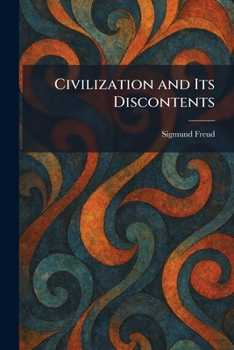
Civilization and Its Discontents

"Civilization and Its Discontents" is one of Sigmund Freud's most influential and enduring works, exploring the fundamental tension between the individual's pursuit of instinctual freedom and the constraints imposed by society. In this profound psychological study, Freud argues that civilization is built upon the sublimation and repression of human drives-specifically the libidinal and aggressive instincts-leading to a pervasive sense of discontent and guilt among its members.
By examining the origins of communal life, the role of the superego, and the development of morality, Freud provides a compelling analysis of the inherent contradictions within human culture. He suggests that the security and progress offered by social structures come at the cost of personal happiness, creating a permanent state of psychological conflict. This landmark text remains a cornerstone of psychoanalytic theory and social philosophy, offering vital insights into the complexities of human nature and the challenges of living within the modern world.
This work has been selected by scholars as being culturally important, and is part of the knowledge base of civilization as we know it. This work was reproduced from the original artifact, and remains as true to the original work as possible. Therefore, you may see the original copyright references, library stamps (as most of these works have been housed in our most important libraries around the world), and other notations in the work.
This work is in the public domain in the United States of America, and possibly other nations. Within the United States, you may freely copy and distribute this work, as no entity (individual or corporate) has a copyright on the body of the work.
As a reproduction of a historical artifact, this work may contain missing or blurred pages, poor pictures, errant marks, etc. Scholars believe, and we concur, that this work is important enough to be preserved, reproduced, and made generally available to the public. We appreciate your support of the preservation process, and thank you for being an important part of keeping this knowledge alive and relevant.
Customer Reviews
ThriftBooks ® and the ThriftBooks ® logo are registered trademarks of Thrift Books Global, LLC
