





Book Overview
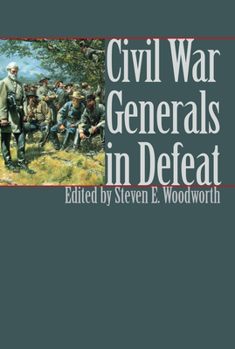
Commanders who serve on the losing side of a battle, campaign, or war are often harshly viewed by posterity. Labeled as mere "losers," they go unrecognized for their very real abilities and achievements in other engagements. The writers in this volume challenge such simplistic notions. By looking more closely at Civil War generals who have borne the stigma of failure, these authors reject the reductionist view that significant defeats were due simply to poor generalship. Analyzing men who might be considered "capable failures"--officers of high pre-war reputation, some with distinguished records in the Civil War--they examine the various reasons these men suffered defeat, whether flaws of character, errors of judgment, lack of preparation, or circumstance beyond their control. These seven case studies consider Confederate and Union generals evenhandedly. They show how Albert Sidney Johnston failed in the face of extreme conditions and inadequate support; how Joe Hooker and John C. Pemberton were outmatched in confrontations with Lee and Grant; how George B. McClellan in the Peninsula Campaign and Don Carlos Buell at Chattanooga faced political as well as military complications; and how Joseph E. Johnston failed to adapt to challenges in Virginia. An additional chapter looks at generals from both sides at the Battle of Gettysburg, showing how failure to adjust to circumstances can thwart even the most seasoned leader's expectations. "There is far more to be learned in trying to understand how and why a general fell short," observes Steven Woodworth, "than there is in multiplying denunciations of his alleged stupidity." Civil War Generals in Defeat successfully addresses that need. It is a provocative book that seeks not to rehabilitate reputations but to enlarge our understanding of the nature and limitations of military command.
Format:Hardcover
Language:English
ISBN:0700609431
ISBN13:9780700609437
Release Date:April 1999
Publisher:University Press of Kansas
Length:248 Pages
Weight:1.19 lbs.
Dimensions:1.0" x 6.2" x 9.4"
Related Subjects
Campaigns & Battlefields Civil War Confederacy History Modern (16th-21st Centuries)Customer Reviews
4 ratings
Interesting, but a bit uneven
Published by Thriftbooks.com User , 16 years ago
This is an interesting compilation of essays on generals in defeat in the Civil War. The editor, Steven Woodworth is a fine scholar of the Civil War, and this book makes a nice addition to a Civil War library. The book states at the outset (Page 2): "War is a hard business, and well may its rule, its test of merit, be hard. . . .Most of all, [a general] had better produce results. The general is not employed to make a good attempt, fight nobly, and lose impressively." The first chapter, by Woodworth himself, focuses on Albert Sidney Johnston. Johnston's reputation coming into the Civil War was impressive. Jefferson David made him commander-in-chief of the western Confederacy. However, with the fall of Forts Henry and Donelson, things unraveled, and Johnston took a lot of criticism. The chapter outlines the arc of his career, ending with the defeat at Shiloh. There is a nice evaluation of Johnston's strengths and weaknesses. A second chapter feature Joseph Johnston's command in the east until his wounding at Seven Pines. Alan Downs does a nice job crediting Johnston with more aggressiveness than he is normally granted. However, Johnston's prickliness and political ineptitude are chronicled nicely here. Other chapters consider George McClellan's Peninsula Campaign and his retreat to the James, Don Carlos Buell's poor performance at Chattanooga, Fighting Joe Hooker's generalship at Chancellorsville (where he comes of, in Stephen Sears' view, as less inept than normally considered). There is an almost poignant consideration of John Pemberton, who would have made a fine staff officer but had no business being named a combat commander. Finally, Robert E. Lee at Gettysburg, a chapter authored by Brooks Simpson. Many have been blamed for the failure of the Confederate forces at Gettysburg. Simpson focuses on Lee's style of delegation at this bloody fight. This is hardly a revolutionary judgment, as others have made a similar argument. But his analysis, nonetheless, appears pretty solid. Overall, this volume works pretty well. Some of the chapters do not seem quite as well developed as I would like. The writing is a bit uneven. Nonetheless this is an interesting work of unsuccessful command.
Worthwhile addition to your library
Published by Thriftbooks.com User , 19 years ago
A.S. Johnston, J.E. Johnston, McClellan, Don Carlos Buell, "Fighting Joe" Hooker, John Pemberton and Robert E. Lee, seven generals that suffered defeat. The format is twenty to forty pages on each man by a respected historian. This is both the strength and the weakness of the book, as the format forces the author to be brief but allows him sufficient room to develop his idea. Pemberton is the weakest essay not because Michael Ballard does a poor job but because Pemberton is doomed by temperament, circumstances and U.S. Grant being such a superior general. Stephen Sears' thought provoking essay on Hooker presents some unexpected ideas even after reading his book on Chancellorsville. The two Johnston essays are well written, very informative while staying within the norms for these men. ASJ is over whelmed by the size of his command and unable to gain control over his subordinates. Alan Downs' JEJ is more aggressive than we normally accept but still unable or unwilling to accommodate civilian controls. I enjoyed Stephen Engle's essay on Buell and the theory of conciliation. Buell is trapped by his ideas, unwilling and unable to make adjustments losses everything. The Campaign to Chattanooga is the basis for his failure presenting the idea of conciliation facing the reality of secession. The essay on McClellan by Ethan Rafuse is a treat. His "McClellan's War" is in the forefront of our rethinking of this man. This is the earliest publications of his work I have read and enjoyed seeing the development of his ideas. Brooks Simpson's essay on Lee at Gettysburg is excellent. Accepting the role of the small boy who says the Emperor is naked, he presents a well-balanced historically accurate picture of Lee's battle management. The approach to battle management of Meade gives the reader an excellent view of what he did and how the different approaches influenced the battle. The small essay on Jackson at Gettysburg is excellent and may cause some to rethink this idea. His ideas on how the Army of the Potomac was different at Gettysburg highlight Lee's failure to make adjustments and contribute to his defeat. This is the strongest essay in the book and the most enjoyable. This is a worthwhile book and a valuable addition to your library. Each essay is well thought out and written by a top shelf historians. Little of the presented is new or groundbreaking but all of it is informative and some of it thought provoking.
Innovative perspectives, but some special pleading
Published by Thriftbooks.com User , 25 years ago
Someof the essays in this collection are simply superb, including Brooks Simpson's insightful examination of Gettysburg -- an essay that raises telling questions about how people traditionally evaluate command performance. Others are the sort of special pleading that proves tiresome, including Stephen Sears's brief on behalf of Joe Hooker.
Even-handed review and good logic
Published by Thriftbooks.com User , 26 years ago
Interesting perspective on the generals examined, & very logical. Stephan Sears' discussion of Hooker's performance at Chancellorsville was the most interesting, and made me reconsider my previous opinions on him. The writers also bring to the table solid analysis, such as Albert Sidney Johnston's management style. I found much of their assertions convincing.
Copyright © 2026 Thriftbooks.com Terms of Use
| Privacy Policy | Do Not
Sell/Share My Personal Information | Cookie Policy | Cookie Preferences | Accessibility Statement
ThriftBooks® and the ThriftBooks® logo are registered trademarks of Thrift Books Global, LLC
ThriftBooks® and the ThriftBooks® logo are registered trademarks of Thrift Books Global, LLC
