


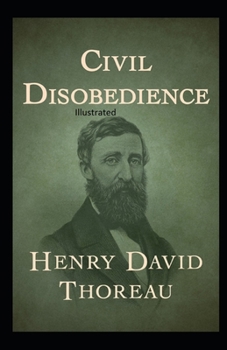
Civil Disobedience Illustrated

Resistance to Civil Government, called Civil Disobedience for short, is an essay by American transcendentalist Henry David Thoreau that was first published in 1849. In it, Thoreau argues that individuals should not permit governments to overrule or atrophy their consciences, and that they have a duty to avoid allowing such acquiescence to enable the government to make them the agents of injustice. Thoreau was motivated in part by his disgust with slavery and the Mexican-American War (1846-1848).
Format:Paperback
Language:English
ISBN:B08JDTKFPR
ISBN13:9798687137898
Release Date:January 1
Publisher:Independently Published
Length:44 Pages
Weight:0.14 lbs.
Dimensions:0.1" x 5.5" x 8.5"
Customer Reviews
1 rating
Henry, you are so radically disobedient.
Published by bernie4444 , 8 months ago
(Original Title: Resistance to Civil Government)
Now (Civil Disobedience)
Occasionally (On the Duty of Civil Disobedience)
Before reading his essays, you will want to know that to know he is one of those American Transcendentalists.
I knew that Henry David Thoreau was a tax evader; however, I did not realize how radical he was until I read his book on the duty of civil disobedience.
Sourced from a lecture Thoreau gave in 1848 titled "The Rights and Duties of the Individual in relation to Government"
He starts with "The government is best which governs not at all." This should have tipped me off to what was going to come next.
What would Timothy McVeigh think if he had read this (and he might have):
"Unjust laws exist: shall we be content to obey them, or shall we endeavor to amend them, and obey them until we have succeeded, or shall we transgress them at once?"
Henry David Thoreau's discussion of democracy verging on mob rule or only majority rule could have also incited certain well-known people. If you put your hand over the title and read the sentences, they could've been dropped into "Mein Kampf" and fit very well.
The bottom line in his dissertation is stated:
"There will never be a free and enlightened State until the State comes to recognize the individual as a higher and independent power, from which all its power and authority are derived, and treats him accordingly."
Copyright © 2026 Thriftbooks.com Terms of Use
| Privacy Policy | Do Not
Sell/Share My Personal Information | Cookie Policy | Cookie Preferences | Accessibility Statement
ThriftBooks® and the ThriftBooks® logo are registered trademarks of Thrift Books Global, LLC
ThriftBooks® and the ThriftBooks® logo are registered trademarks of Thrift Books Global, LLC
