


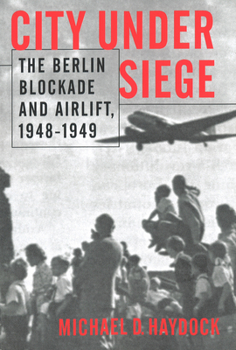
City Under Siege: The Berlin Blockade and Airlift, 1948-1949


Select Format
Select Condition 
Book Overview
At the close of World War II, the Soviet Union controlled all of eastern Germany with the exception of the American, British, and French sectors of Berlin. In June 1948, Soviet authorities halted the West's land access to the city, apparently dooming the inhabitants of its Western sectors to starvation. Would half of Berlin remain free and democratic, or would it succumb to Stalin's stranglehold? American and British planes immediately began a massive airlift that would last for fifteen months. Flying 276,926 dangerous missions, often in bad weather, and bringing in 2.3 million tons of food and coal, the legendary Berlin Airlift cost the lives of 75 U.S. and British airmen but saved the besieged enclave. Focusing on the experience of airmen, politicians, and ordinary citizens, historian Michael D. Haydock tells the human story of a spectacular aviation and logistical accomplishment that has had lasting geopolitical significance.
Format:Paperback
Language:English
ISBN:1574882643
ISBN13:9781574882643
Release Date:July 2000
Publisher:Potomac Books
Length:322 Pages
Weight:1.10 lbs.
Dimensions:0.9" x 6.2" x 9.2"
Related Subjects
Aviation Ethnic & National Europe Germany History Irish Military Modern (16th-21st Centuries) WorldCustomer Reviews
1 rating
A significant addition to the history of the cold war.
Published by Thriftbooks.com User , 26 years ago
Michael Haydock provides a significant addition to the history of the cold war. This book is a seamless review of the role Berlin played during the critical years that ran from the end of World War II until the fall of the Berlin Wall. Haydock mirrors Berlin against the larger global events of the period. The central focus of the manuscript is, simply, how a city the size of Philadelphia survived complete destruction by the Soviet Army and rose again from the ashes in search of self determination.With Berlin as the backdrop, the author uses three themes in weaving the story. The first theme outlines the strategic decision making which contrasts the leadership of the Allies and the Soviet Union during the Berlin crisis. A stark difference emerges immediately. The democratically elected leaders of the Allies set the strategy. For example, President Truman said, "we stay," and turned the formation of policy over to his appropriate cabinet members. General Marshall, Secretary of State and James Forrestal, Secretary of Defense, set broad policy which protected the strategic interest of the United States and delegated operational decisions to command officers in the field. Generals Clay, LeMay, Tunner, and their staffs made the tactical decisions while keeping Washington briefed. The author goes to great lengths to show how those in the field made the big decisions with minimal interference from the highest level.Decision making by the Soviet Union was the opposite. Haydock uses extensive documentation from a variety of sources to illustrate Soviet decision making as a highly rigid, centralized system that required all matters to be cleared with Moscow - that is, with Stalin. Such tightly controlled decision making begged for delay as every action went back to Moscow for a reaction.The second theme is operational or tactical. Haydock goes to great lengths to describe the birth, growth, and triumph of the Berlin Airlift. As the Soviets closed the surface routes to Berlin, a hasty effort to supply the city by air was made by the area commanders. The question, "can it be done?" was not addressed; however, the question, "how can we do it?" was a constant for the next six months. One could classify the beginning air supply effort as long on optimism and short on reality. On Saturday, July 26, 1948, a collection of C-47s made thirty-four flights into Templehof with 80 tons of food and medicine. The Berlin Airlift had commenced.Manpower and material began to flow to the operational bases in West Germany. General Tunner arrived to provide leadership. The C-54s began to arrive from bases all over the world. The "bicycle chain" was applied to the corridors which kept a steady stream of aircraft moving toward the landing fields in Berlin and back to the supply airfields. January, 1949, was a critical month. The weather was bad and the City was down to twelve days of food and coal. On Easter Sunday, 1949, flying at one minute
Copyright © 2026 Thriftbooks.com Terms of Use
| Privacy Policy | Do Not
Sell/Share My Personal Information | Cookie Policy | Cookie Preferences | Accessibility Statement
ThriftBooks® and the ThriftBooks® logo are registered trademarks of Thrift Books Global, LLC
ThriftBooks® and the ThriftBooks® logo are registered trademarks of Thrift Books Global, LLC
