


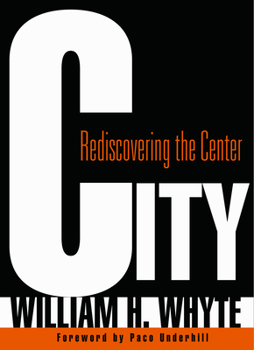
City: Rediscovering the Center


Select Format
Select Condition 
Book Overview
Named by Newsweek magazine to its list of "Fifty Books for Our Time."
For sixteen years William Whyte walked the streets of New York and other major cities. With a group of young observers, camera and notebook in hand, he conducted pioneering studies of street life, pedestrian behavior, and city dynamics. City: Rediscovering the Center is the result of that research, a humane, often amusing view of what is staggeringly obvious about the urban environment but seemingly invisible to those responsible for planning it. Whyte uses time-lapse photography to chart the anatomy of metropolitan congestion. Why is traffic so badly distributed on city streets? Why do New Yorkers walk so fast--and jaywalk so incorrigibly? Why aren't there more collisions on the busiest walkways? Why do people who stop to talk gravitate to the center of the pedestrian traffic stream? Why do places designed primarily for security actually worsen it? Why are public restrooms disappearing? "The city is full of vexations," Whyte avers: "Steps too steep; doors too tough to open; ledges you cannot sit on. . . . It is difficult to design an urban space so maladroitly that people will not use it, but there are many such spaces." Yet Whyte finds encouragement in the widespread rediscovery of the city center. The future is not in the suburbs, he believes, but in that center. Like a Greek agora, the city must reassert its most ancient function as a place where people come together face-to-face.Format:Paperback
Language:English
ISBN:0812220749
ISBN13:9780812220742
Release Date:September 2009
Publisher:University of Pennsylvania Press
Length:408 Pages
Weight:1.95 lbs.
Dimensions:0.8" x 7.0" x 10.0"
Customer Reviews
3 ratings
Classic Sociological Work Using Participant Observation and Photography to Study Urban Life
Published by Thriftbooks.com User , 17 years ago
Form Introduction: "A good part of this book is concerned with the practical, and in particular, the design and management of urban spaces. But my main interest has been in matters much less practical - or, as I would prefer to term it, fundamental research. Whatever may be the significance, what is most fascinating about the life of the street is the interchanges between people that take place in it. A word about methodology. Direct observation was the core of our work. We did do interviewing, and occasionally we did experiments. But mostly we watched people. We tried to do it unobtrusively and only rarely did we affect what we were studying. We used photography a lot: 35 mm for stills, Super 8 for time-lapse, and 16mm for documentary work. " Chapter Contents: * The Social Life of the Street * Street People * The Skilled Pedestrian * The Physical Street * The Sensory Street * The Design of Spaces * Water, Wind, Trees, and Light * The Management of Spaces * The Undesirables * Carrying Capacity * Steps and Entrances * Concourses and Skyways * Megastructures * Blank Walls * The Rise and Fall of Incentive Zoning * Sun and Shadow * Bounce Light * Sun Easements * The Corporate Exodus * The Semi-Cities * How to Dullify Downtown * Tightening Up * The Case for Gentrification * Return to the Agora
Excellent
Published by Thriftbooks.com User , 22 years ago
I'd give it five stars as an urban planning book, but only four stars in comparison to Whyte's landmark The Organization Man, a truly great, but nearly forgotten book of the fifties. The analysis of corporations moving from Manhattan to the suburbs, wherein Whyte plots distance from the CEOs home to the new headquarters is priceless.
Essential reading for any urban planner.
Published by Thriftbooks.com User , 26 years ago
This book is terrific because William Whyte doesn't relie on any theory. Instead, he logged countless hours watching street corners, public parks and plazas to see how people actually use them, and draws conclusions on how to make them better, safer, and useable. His ideas of planning public areas were first used to a great extent in redeveloping Bryant Park in NYC. Formally a haven for drug users, the city used his findings from this book and turned it into one of the city's most livable and exciting public areas. If only we could design all our streets and plazas with such good common sense!
Copyright © 2026 Thriftbooks.com Terms of Use
| Privacy Policy | Do Not
Sell/Share My Personal Information | Cookie Policy | Cookie Preferences | Accessibility Statement
ThriftBooks® and the ThriftBooks® logo are registered trademarks of Thrift Books Global, LLC
ThriftBooks® and the ThriftBooks® logo are registered trademarks of Thrift Books Global, LLC
